

Every April, when the anniversary rolls around, the conversation follows the same pattern: the astonishing ten-course first-class dinner, the champagne, the Punch Romaine, the Filet Mignons Lili. And it’s genuinely impressive — I’ve cooked every one of those dishes over the past fifteen years, and some of them still intimidate me.
But focusing only on first class misses the real story. Because the most remarkable thing about food on the Titanic wasn’t what the wealthy ate. It was what the poor ate.
More than 700 people travelled in third class on the Titanic’s maiden voyage. Most of us can picture steerage because of James Cameron. His 1997 film — which turns 30 next year — gave us Jack Dawson, a kid who won his third-class ticket in a poker game and boarded the Titanic with nothing but a sketchbook and a best friend. Jack wasn’t based on a single real person, but he represents hundreds of them: young emigrants with no money, no connections, and no idea that the ship carrying them toward a new life wouldn’t reach its destination. Cameron understood that the real story of the Titanic wasn’t in the first-class dining room. It was below decks. The vast majority were emigrants — leaving Ireland, Scandinavia, Eastern Europe, and the Middle East for a new life in America. Many had never eaten in a proper dining room. Some had never used an indoor toilet. And for a significant number of them, the meals served in the Titanic’s third-class dining saloon were the finest food they had ever been given.
That’s the story worth telling on the 114th anniversary. Not the luxury at the top, but the unexpected dignity at the bottom.
What “Steerage” Actually Meant in 1912
The word “steerage” comes from the location of the accommodation — the lowest decks, near the ship’s steering apparatus. No windows. No views. On most ships of the era, steerage was grim: open dormitories, shared bunks, and passengers were often required to bring their own food for the entire voyage.
The Titanic changed that. White Star Line was competing fiercely for the emigrant trade — it was, in fact, where the real money was. German ships out of Hamburg and Bremen, British ships out of Southampton and Liverpool — all of them chasing the same passengers. So White Star made a decision that was as much commercial as it was humanitarian: third-class passengers on the Titanic would be fed. Three meals a day. Included in the ticket price. Served by stewards at proper tables.
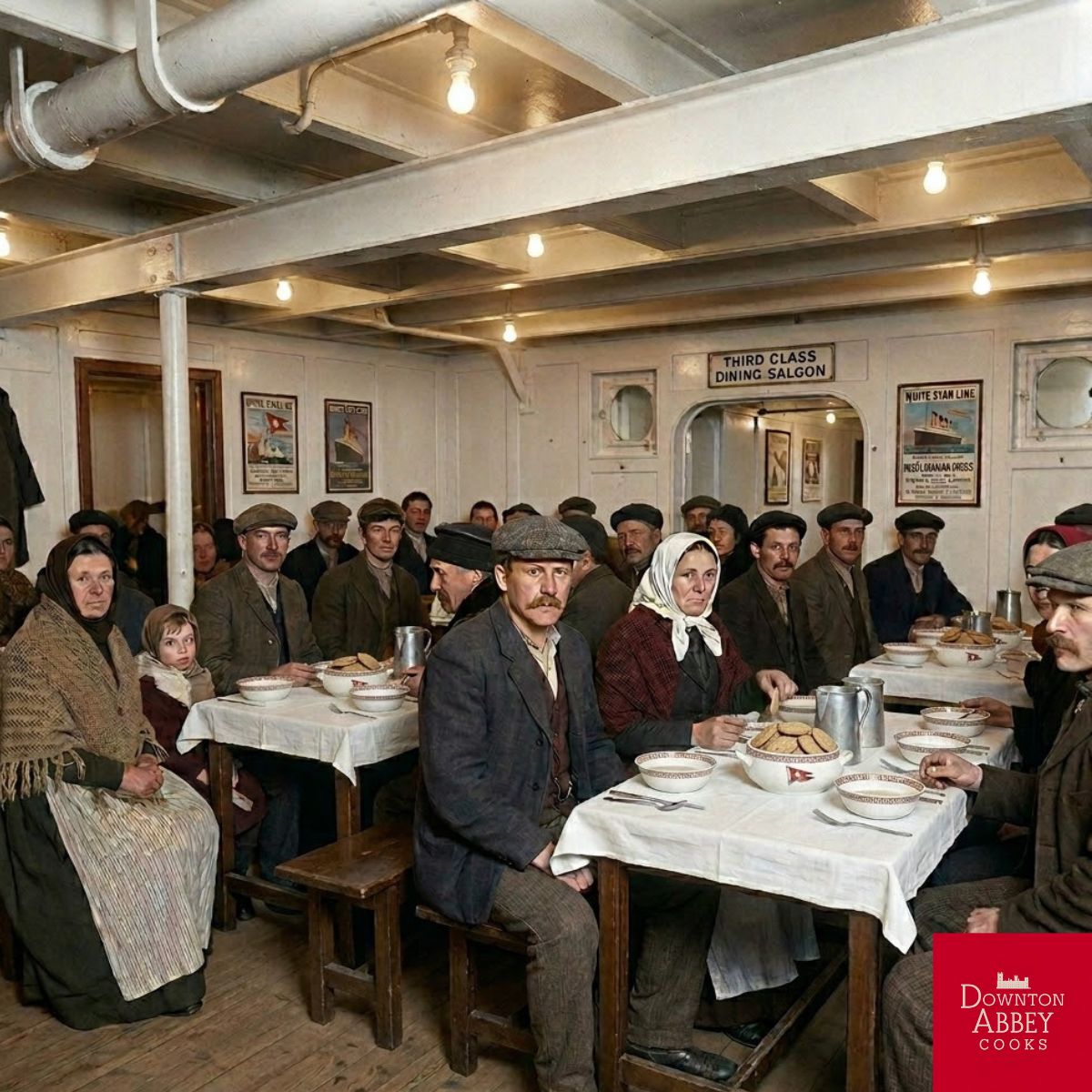
The Titanic’s third class was said to resemble second class on competing steamships. The dining saloon was divided into two rooms by a watertight bulkhead. Long, solid-wood tables that seat up to 22 people each. The rooms could accommodate 400 diners, with two sittings if needed. The walls were enamelled white and brightened by sidelights. It was plain, yes. But it was a real dining room, with real table service, for people who had likely never experienced either.
The forward room was reserved for families and single women. The aft room was for single men. Coats were hung on hooks around the walls — there was no cloakroom. But there were menus. And those menus tell a story.
Three Meals a Day: What Third Class Actually Ate
On April 14, 1912 — the last full day of the Titanic’s voyage — third-class passengers were served three substantial meals:
Breakfast: Oatmeal porridge with milk, vegetable stew, fried tripe and onions, bread and butter, marmalade, Swedish bread, tea, and coffee.
Lunch: Bouillon soup, roast beef with brown gravy, boiled green beans, potatoes, cabin biscuits, bread, and prunes with rice.
Dinner: Rice soup, fresh bread, plum pudding, fruit, and tea.
Freshly baked bread and fruit were available at every meal.
Read that list again. Roast beef. Plum pudding. Fresh bread at every meal. Porridge with milk. For people leaving famine-scarred Ireland, for families from villages in Sweden where meat was a rare luxury, for emigrants from Eastern Europe who had been eating black bread and potatoes for years — this was extraordinary.
One historical account notes that most ocean liners of the period required third-class passengers to bring their own provisions for the voyage. The Titanic not only fed them — it fed them well. Three courses at dinner. Fresh fruit. Plum pudding for dessert. The food was plain by first-class standards, but it was fresh, it was hot, and there was plenty of it.
The Downton Abbey Connection
Downton Abbey fans understand this dynamic intuitively. The entire series is built on the tension between upstairs and downstairs — between the Crawleys’ elaborate dinner parties and the servants’ hall meals that Mrs. Patmore prepared with equal care but a fraction of the budget.
The Titanic’s class structure was the Downton divide made literal. First class was upstairs: ten courses, Escoffier-influenced cuisine, champagne between courses, a staff of 80 in the kitchen. Third class was downstairs: hearty food, honestly prepared, served at long communal tables. And just as at Downton, the people downstairs often had more fun. James Cameron captured this perfectly — Rose sneaking down to steerage to dance with Jack, the energy and warmth of the communal space versus the stiff formality above.
The show opens with the Titanic because the sinking shattered the certainty of the Edwardian class system. The heirs died. The money was suddenly at risk. And the assumption that those at the top were protected by their position proved catastrophically wrong. Third-class passengers had the lowest survival rate — not because the food was bad, but because the lifeboats were not meant for them.
Why This Matters 114 Years Later
When we only talk about the Titanic’s first-class menu — the Consommé Olga, the Filet Mignons Lili, the ten-course spectacle — we unconsciously replicate the same class bias that the Edwardians built into the ship. We remember the wealthy because their menus were more photogenic, their dining rooms more glamorous, their stories more dramatic.
But more than 700 people ate in that plain white dining room on April 14th. Most of them were heading toward a life they’d never lived before, eating food they’d never been served before, in a room nicer than any they’d ever entered. And most of them didn’t survive the night.
Cooking their food is one way to remember them. Not the elaborate dishes of first class, but the simple ones: rice soup, roast beef, plum pudding, cabin biscuits. The food of people in transit, between one life and another, who sat down to a good meal and didn’t know it was their last.
Cook It Yourself: The Third-Class Menu
If you want to honour the steerage passengers this April 14th, here’s the full third-class dinner menu with links to recipes you can make at home. None of these are difficult. Most can be prepared in under an hour. They’re the kind of food you’d actually want to eat on a weeknight — which is part of the point.
Rice Soup — Mrs. Beeton’s recipe, adapted for modern kitchens. A simple, warming broth.
Cabin Biscuits — The original ship’s biscuit, also known as hardtack. A 15-minute bake and a great activity with kids.
Plum Pudding — Yes, plum pudding in steerage. A traditional recipe that takes time but rewards patience.
For the full third-class menu breakdown and more Titanic dishes across all classes, visit the complete 3rd Class Menu page on Downton Abbey Cooks.
Hosting a Steerage Dinner Party
A steerage dinner party is the most accessible way to mark the Titanic anniversary. No elaborate courses. No French technique. Just good, honest food served at a communal table.
Set the table simply: plain white cloth if you have one, long table, no individual place settings. Serve everything family-style. Put out bread and butter before guests sit down. Pour tea or beer — third-class passengers had access to both.
If you want to set the mood, there’s a detail from the actual Titanic that’s worth borrowing: the third-class dining room had no cloakroom, so passengers hung their coats on hooks around the walls. There’s something wonderfully informal about that. No pretension. No ceremony. Just people sitting down together.
And if you really want to honour the moment, raise a glass at 11:40 PM — the time the Titanic struck the iceberg. Remember the people who were in that dining room just hours earlier, eating the best meal of their lives, heading toward a future that never arrived.
Great food has a history. Theirs deserves to be remembered.