

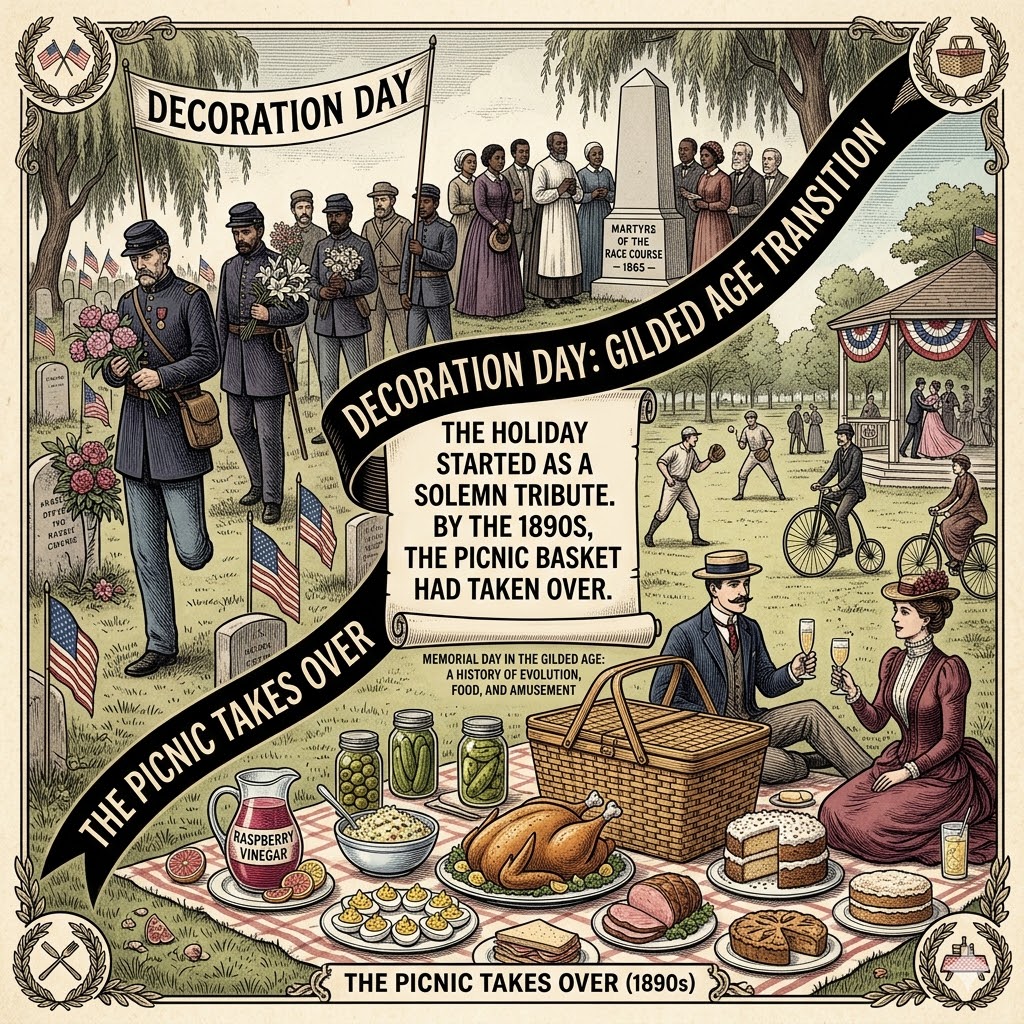
Memorial Day did not start with barbecues and beer. It started with flowers and grief.
The roots of the holiday go back to May 1865, just weeks after the Civil War ended. In Charleston, South Carolina, thousands of freed Black Americans and white missionaries gathered at a former horse-racing track where Confederate forces had buried Union prisoners in mass graves. They reburied the dead with dignity, built a fence around the site, and called it “Martyrs of the Race Course.” Then, as historian David Blight’s research documented, the crowd dispersed into the infield and did what Americans have been doing at outdoor gatherings ever since: they had a picnic, listened to speeches, and watched soldiers drill.
That combination — solemnity in the morning, food and leisure in the afternoon — defined the holiday for the next three decades.
From Decoration Day to the Gilded Age Table
The holiday got its official name, Decoration Day, in 1868 when Major General John A. Logan of the Grand Army of the Republic called for a national day to decorate the graves of fallen Union soldiers. He chose May 30 because it was not the anniversary of any particular battle, and because late May offered, in his words, “the choicest flowers of springtime” across the whole country.
By 1889, the holiday had become national. By then, the United States was deep in the Gilded Age — roughly 1877 to 1901 — a period of rapid industrial growth, immigrant waves, vast wealth inequality, and, at the table, a very particular food culture.
The Gilded Age was, above all else, excessive. The era’s elite dined on eight to twelve-course French-inspired meals. Delmonico’s in New York set the standard. Charles Ranhofer, the restaurant’s Parisian-trained chef, invented Lobster Newberg and Baked Alaska and wrote an 1,100-page culinary bible called The Epicurean. Menu cards were printed in French as a matter of course.
But that was Tuesday dinner at the Vanderbilts. Decoration Day was a public holiday. It belonged to everyone.
The Picnic Takes Over
Something interesting happened to Decoration Day in the 1880s and 1890s. The solemn part — the parade, the cemetery, the hymns — happened in the morning. Then businesses closed for the day, the sun came out, and Americans went to the park.
Newspaper reports from the 1890s described bicycle races in Pittsburgh, public dances in Akron, and baseball games in towns across the country. The Wheeling Daily Intelligencer complained in 1899 that the holiday had become an occasion for “picnics, outings, and other amusements,” despite the best efforts of veterans’ groups to preserve its purpose. The Grand Army of the Republic leadership was particularly irritated that baseball had become a Decoration Day fixture.
In the 1880s, President Grover Cleveland reportedly spent the holiday fishing. People were appalled. By 1911, the first Indianapolis 500 ran on May 30 to a crowd of 85,000. The Associated Press covered it without mentioning the holiday.
The drift from mourning to leisure was not a betrayal. It was, as historians now read it, a natural evolution: a holiday that marks the beginning of summer, in a country that was becoming wealthier and more mobile, was always going to attract a picnic basket.
What Was in That Basket
The Gilded Age picnic had a very specific menu. It was built around one constraint: no refrigeration, no kitchen on-site, and a long walk or carriage ride to get there.
Cold roast chicken was the anchor. It traveled well, tasted better at room temperature than most foods, and fed a crowd without drama. Cookbooks of the era listed it as the default picnic centrepiece. A spring picnic menu from Queen of the Household (Mrs. M.W. Ellsworth, c. 1900) included cold roast chicken, cold baked ham, egg salad, hard-boiled eggs, buttered rolls, sandwiches of potted rabbit and bewitched veal, chow chow, pickles, orange marmalade, quince jelly, sugared strawberries, white cake, almond cake, and lemonade.
That was a typical middle-class spread. Not Delmonico’s. But not humble, either.
The standard picnic basket of the 1890s — which became, as food historians note, the “chief icon” of the American picnic — typically contained:
Proteins: Cold fried chicken, ham, cold cuts, tongue, meat-filled sandwiches
Eggs: Hard-boiled, deviled, or stuffed
Salads: Egg salad, chicken salad, cabbage slaw
Bread and condiments: Buttered rolls, pickles, olives, jellies, mustard
Sweets: Coconut cake, almond cake, sponge cake, cookies, tarts
Drinks: Lemonade, ginger beer, cider, raspberry vinegar, beer, wine
Raspberry vinegar was a popular summer drink — tart, refreshing, non-alcoholic — made by macerating fresh raspberries in vinegar, then mixing the strained liquid with sugar and water. It appeared on respectable middle-class picnic menus throughout the 1880s and 1890s.
Mayonnaise, newly popularized in American kitchens, showed up in chicken salads and egg salads. Sandwiches were filled with ground or chopped meats — roast beef, tongue, and ham mixed with butter and mayonnaise — not the simple sliced-meat constructions of earlier decades.
The Class Divide at the Picnic Grounds
The Gilded Age was not subtle about class. Even picnics had a hierarchy.
Working-class families spread a blanket in the municipal park and ate cold fried chicken, cornbread, potato salad, and lemonade from a jar. Middle-class families packed hampers with cold roast chicken, a proper egg salad, cakes in tins, and bottles of homemade beverages.
Wealthier families took the same foods but elevated the presentation: cut glass and proper cutlery carried out to the lawn, cold lobster alongside the chicken, champagne alongside the lemonade, and food from the kitchen rather than from their own hands.
What united all of them was the outdoor table, the suspended rules, and the particular permission that picnics have always offered. As one food historian of the era noted, traditional prohibitions against gluttony were waived at picnics, with the “country air” bearing the blame for any excess of appetite.
What the Veterans Were Eating
Decoration Day observances in most Northern towns followed a pattern: a morning march to the cemetery, graveside ceremonies with flowers, hymns, and a public speech, followed by the dispersal of the crowd into the afternoon.
The Grand Army of the Republic held post dinners and reunions. These were more formal affairs — the equivalent of regimental mess dinners — with ham, roast fowl, baked beans, and pies. The veterans ate together; the civilian public picnicked separately.
By the 1890s, as historian Matthew Dennis notes, the advancing age of Civil War veterans was changing even the morning ceremonies. Outdoor parades were moved indoors in some cities because the veterans could no longer manage the exertion. The holiday’s military gravity was already beginning to shift.
Why This History Matters at the Table
The Gilded Age Decoration Day picnic is the direct ancestor of the modern Memorial Day cookout. The foods have shifted — cold fried chicken became grilled burgers; raspberry vinegar became iced tea — but the structure is identical. Solemnity in the morning, food and leisure in the afternoon.
The tension veterans felt in the 1890s — that the picnic was displacing the purpose — is the same tension people feel today when they see Memorial Day sales ads or beach posts rather than tributes to the fallen.
Food does not dilute a memorial. It has always been part of how communities hold grief together with ordinary life. The 10,000 people who gathered in Charleston in 1865 understood that. They buried the dead with dignity, and then they sat down together and ate.
Frequently Asked Questions
When did Memorial Day start? One of the earliest observances was in Charleston, South Carolina, on May 1, 1865, organized by freed Black Americans honouring Union soldiers. The first national observance, called Decoration Day, was proclaimed for May 30, 1868 by Major General John A. Logan. It became a national holiday in 1889. The name officially changed to Memorial Day in 1967.
Is Memorial Day a Gilded Age tradition? Yes. The holiday was formally established in 1868 and became national in 1889, placing its first two decades squarely in the Gilded Age period (roughly 1877 to 1901). The picnic tradition that now defines Memorial Day weekend developed largely during these years.
What did people eat at Gilded Age picnics? Cold roast chicken, deviled eggs, chicken salad, ham sandwiches, pickles, olives, cakes, and lemonade were standard. Middle-class picnic menus from the 1880s and 1890s also featured cold baked ham, egg salad, buttered rolls, and raspberry vinegar as a drink.
Why did people picnic on Decoration Day? Businesses closed for the holiday, making it a de facto leisure day that coincided with the start of warm weather. After morning cemetery ceremonies, families naturally spent the afternoon outdoors. By the 1890s, newspapers were regularly reporting on Decoration Day picnics, baseball games, bicycle races, and public dances.
What is raspberry vinegar? A popular Victorian-era summer drink made by steeping fresh raspberries in wine vinegar, straining, mixing with sugar, and diluting with water. It was served at Gilded Age picnics as a non-alcoholic, refreshing alternative to lemonade. Think of it as the kombucha of the 1880s — tart, a bit surprising, and very period-correct.
Sources: David Blight, “Race and Reunion” (2001); Matthew Dennis, University of Oregon; National Endowment for the Humanities, “The Evolution of Memorial Day”; Mrs. M.W. Ellsworth, “Queen of the Household” (c. 1900); History.com; PBS NewsHour.
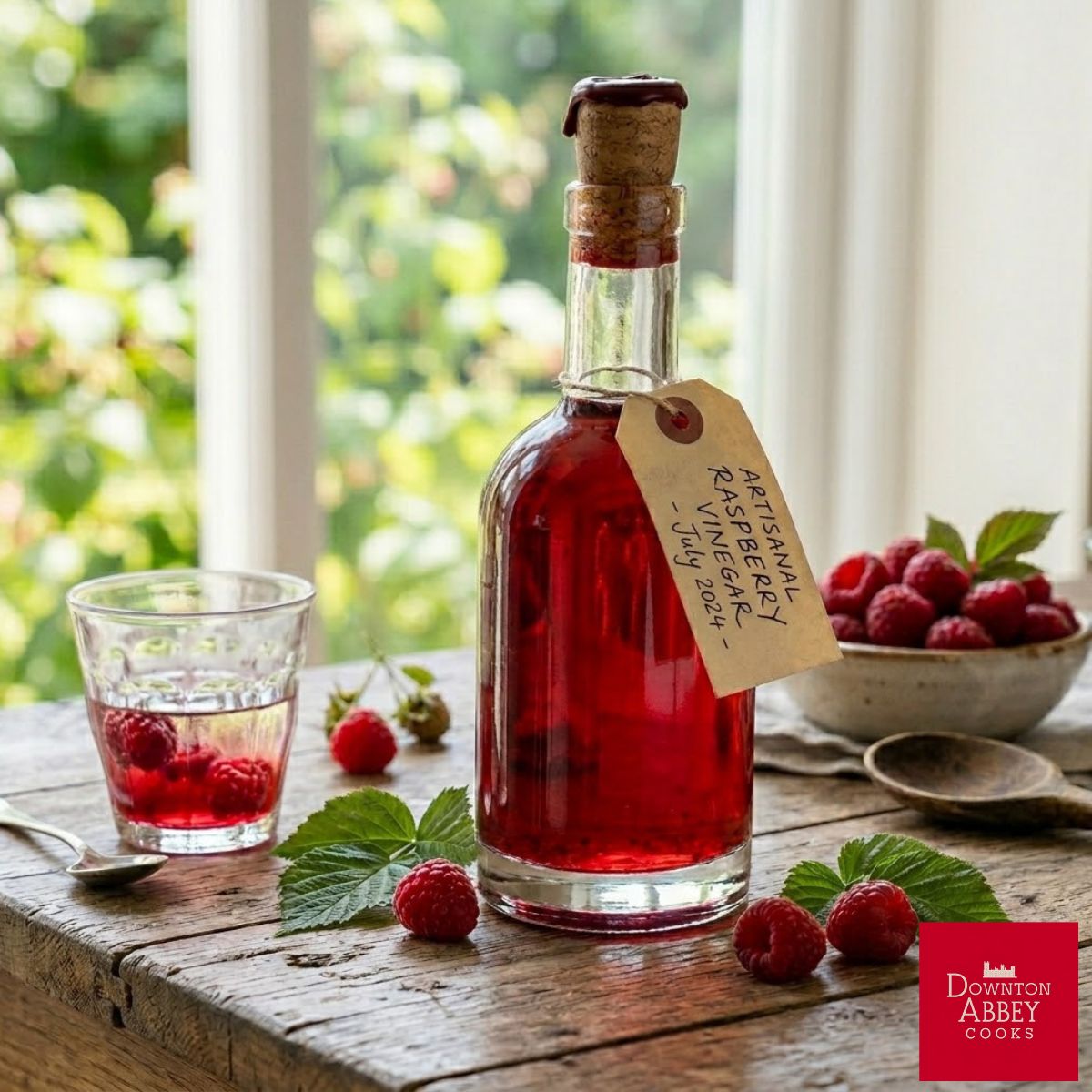
Victorian American Raspberry Vinegar
Ingredients
- 4 cups fresh raspberries divided into two equal portions
- 2 cups white wine vinegar
- 2 cups granulated sugar approximately -- see notes
- Cold or sparkling water to serve


Instructions
First Steep
- Place 2 cups of raspberries in a glass or ceramic bowl. Pour the vinegar over the fruit. Stir gently to bruise the berries slightly. Cover and leave at room temperature for 24 hours. Do not squeeze or crush the fruit -- just let it steep.
Strain and steep again
- After 24 hours, strain the liquid through a fine-mesh sieve into a second bowl, pressing gently to extract the juice. Discard the spent berries. Pour the strained liquid over the second portion of fresh raspberries (the remaining 2 cups). Cover and steep for another 24 hours.
Final strain
- Strain the liquid a second time through a fine-mesh sieve or cheesecloth, pressing well. You should have roughly 2 cups of deep red, intensely flavoured liquid. Discard the spent fruit.
Cook with sugar
- Measure your strained liquid. Add an equal volume of sugar -- so 2 cups of juice gets 2 cups of sugar. Pour into a saucepan, stir over medium heat until the sugar dissolves, then bring to a gentle boil. Simmer for 10 minutes, skimming any foam. The syrup will reduce slightly and thicken.
- Bottle and store
- Remove from heat and cool completely. Pour into clean glass bottles or jars. Seal and refrigerate. Keeps for up to 3 months.
To serve as a drink
- Mix 1 to 2 tablespoons of syrup with cold or sparkling water in a tall glass over ice. Victorian recipes suggest roughly 1 part syrup to 4 parts water, but adjust to taste.