

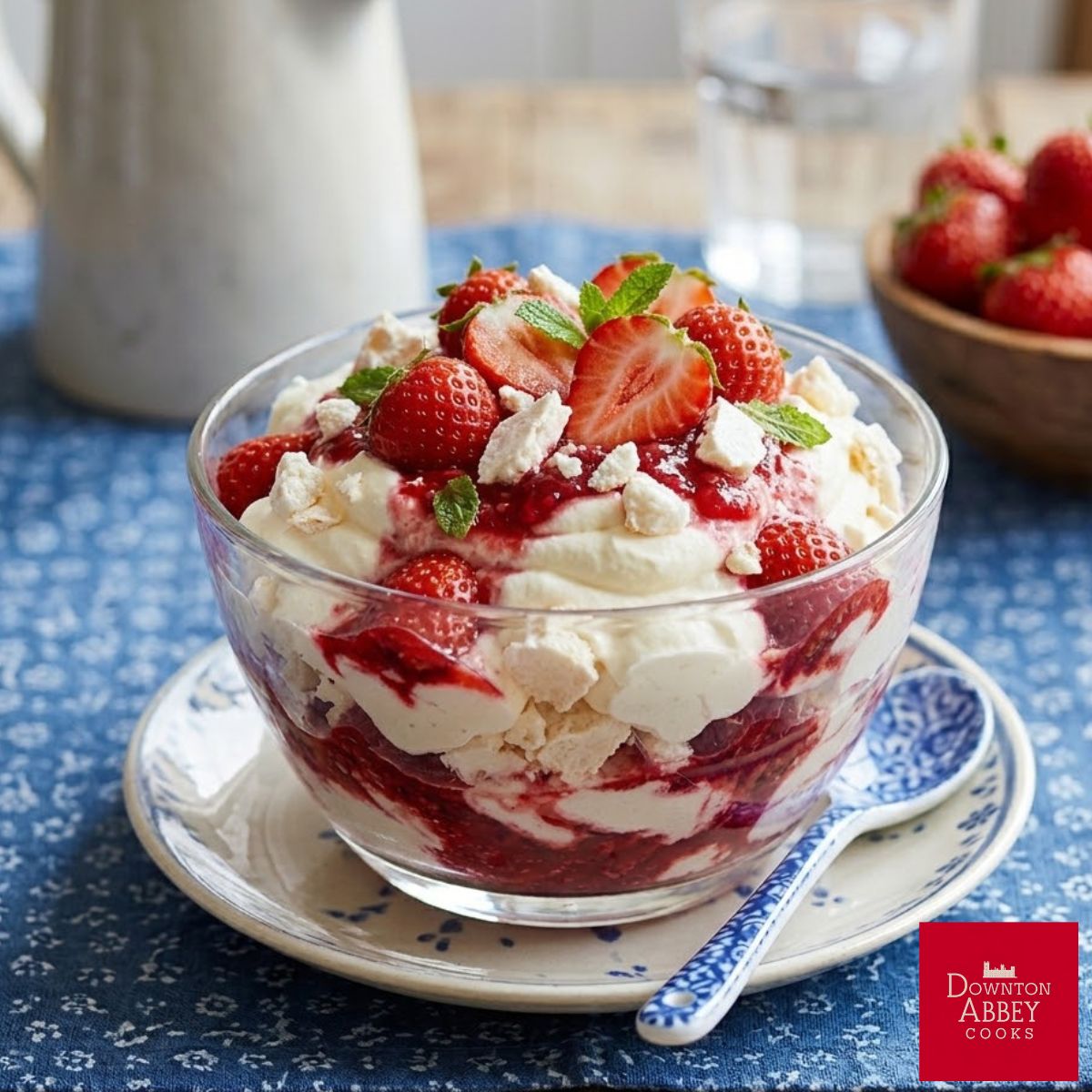
Eton Mess is a British summer dessert made from three things: crushed meringue, whipped cream, and fresh strawberries. It is deliberately imperfect. That is not a flaw. That is the point.
The dessert has been associated with Eton College, the famous English boarding school in Berkshire, since at least the 1930s. It was traditionally served at the annual cricket match between Eton and Harrow, one of the oldest school sporting rivalries in England. The match dates to 1805. The mess came later, but it became a fixture of the occasion.
The Dog Story (and Why It Probably Is Not True)
The most popular origin story goes like this: a Labrador retriever sat on a picnic basket at an Eton cricket match, crushing a pavlova inside. Rather than waste it, someone folded the wreckage together with cream and served it anyway.
It is a good story. It is almost certainly not true. Food historians have found no contemporary account that supports it, and the tale has the hallmarks of a retroactive explanation invented to justify the name. The word “mess” in 19th-century British English simply meant a dish of mixed or soft food, the same root as “mess hall.” No dog required.
Meringue, Strawberries, and the British Summer
What is well documented is that meringue-and-cream combinations were popular in English cooking well before Eton Mess had a name. Syllabubs and fools, both cream-based desserts, appear in British cookbooks as far back as the 17th century. Meringue itself arrived in Britain from France and Switzerland in the 1700s and became fashionable in upper-class households through the 19th century.
Strawberries sealed the deal. England’s strawberry season runs roughly from June through August, which is precisely when the Eton-Harrow cricket match was played. The combination of peak-season strawberries, cream, and broken meringue was less a recipe than an obvious solution to what was on hand.
From School Grounds to Every Garden Party
The dish remained closely associated with Eton for most of the 20th century. Then British food culture changed. The rise of gastropubs, celebrity chefs, and a renewed interest in classic British cooking in the 1990s and 2000s brought Eton Mess out of the school tuck shop and onto restaurant menus. By the time Nigella Lawson and Delia Smith were both publishing their versions, it had fully crossed over into the mainstream.
Today it appears at Wimbledon, Chelsea Flower Show, summer weddings, and back garden barbecues across Britain. It requires no special equipment and no advanced technique. You cannot really make it look bad. Seasonal fruit variations, from raspberries to mangoes to passion fruit, have multiplied. But the classic version, strawberries and meringue, remains the one people reach for first.
Why It Has Lasted
Most dishes tied to specific institutions fade when the occasion does. Eton Mess survived because the combination is genuinely good and genuinely easy. The contrast between crisp meringue and soft cream, between sweet and slightly tart strawberry, works. It also scales up effortlessly, which matters when you are feeding a crowd on a warm afternoon.
It is the rare recipe where the name tells you everything you need to know and still sells it short.
Traditional Eton Mess
Equipment
Ingredients
- 4 cups strawberries, hulled 500 g
- 2 tbsp. caster sugar superfine sugar*
- 2 cups heavy whipping cream 500 m
- 2 tbsp. icing sugar
- 1 tsp. vanilla extract
- 6 meringue nests or homemade**


Instructions
- Macerate the strawberries: Slice about two-thirds of the fresh strawberries, hulled and toss with 2 tablespoons caster sugar (superfine sugar). Set aside for at least 30 minutes. They will release juice and soften slightly. This is what gives the dessert its colour and sauce
- Prepare the remaining strawberries: Halve or quarter the remaining strawberries and set aside. These go in at the end for texture and freshness.
- Whip the cream: Pour the whipping cream into a large chilled bowl. Add the icing sugar and vanilla extract. Whip to soft peaks only. Stop before it gets stiff. You want it to fold and drape, not stand in peaks. Over-whipped cream will make the mess too dense.
- Break the meringue: Roughly crumble in three meringue nests — you will need different-sized chunks for texture, as well as a little fine dust. Leave one cookie to garnish.
- Assemble: Fold the macerated strawberries and their juice through the whipped cream in two or three turns. Add the crushed meringue and the reserved fresh strawberries. Fold again, no more than three or four times. You want visible streaks of strawberry, cream, and meringue. Do not overmix.
- Serve immediately: Spoon into glasses or a large bowl. Serve within 20 minutes. The meringue will begin to soften after that, which is acceptable, but you lose the crunch contrast. Garnish with a fresh strawberry and meringue cookie if you like.