
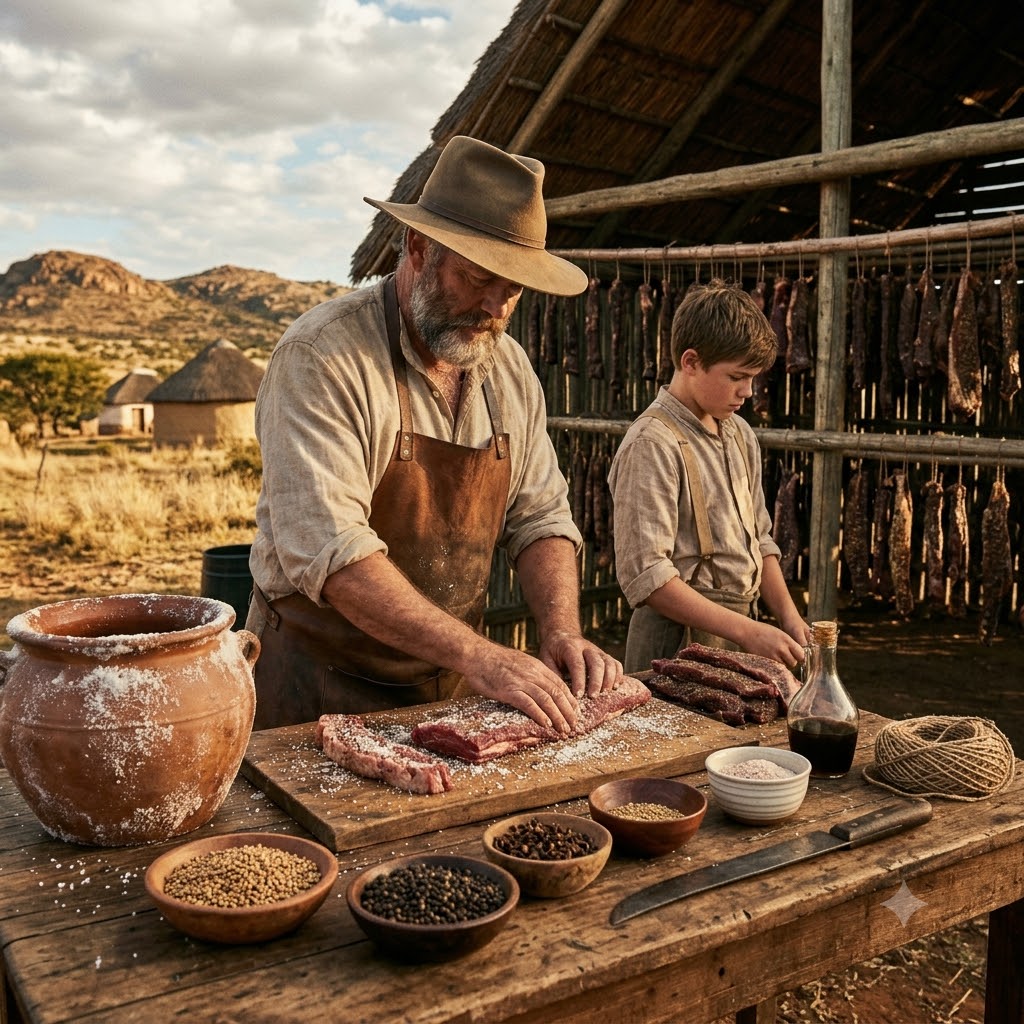
 Every cuisine has its answer to the same old problem: how do you keep meat from spoiling before refrigeration exists? In a grand Edwardian kitchen the solution was salting, potting and curing. Hams hung in the larder, game was preserved, and nothing was wasted. Thousands of miles to the south, at the tip of Africa, cooks were solving exactly the same problem with sun, wind, salt and vinegar. Their answer was biltong, and people have been making it in much the same way for more than three hundred years.
What is biltong?
Biltong is air-dried, cured beef, or sometimes game, cut into strips, seasoned and hung until firm. The name is wonderfully literal. It comes from the Dutch “bil,” meaning rump or hindquarter, and “tong,” meaning strip or tongue. So biltong is simply “a strip of rump.” It is not smoked and not cooked. It is preserved the slow way, by curing and drying alone.
Remarkably little about the method has changed. Makers who still do it the traditional way, like Bokkie’s Biltong, cure their traditional South African biltong with salt, vinegar and coriander and air-dry it slowly, much as it was done three centuries ago.
Where does biltong come from?
Long before Europeans arrived, the indigenous peoples of Southern Africa, among them the Khoikhoi, preserved meat by cutting it into strips, rubbing it with salt and hanging it to dry in the open air. It was survival food: light enough to carry and stable enough to last for months.
When Dutch settlers established a supply station at the Cape in 1652, they brought their own preserving traditions and refined the local method. They added vinegar, which the Cape’s new vineyards supplied in abundance, along with saltpeter to hold harmful bacteria at bay, and spices carried in on the trade routes that rounded the Cape: coriander, pepper and cloves. That marriage of an indigenous drying technique and European curing is essentially the biltong recipe still in use today.
The food that crossed a continent
Biltong earned its place in the South African story during the Great Trek of the 1830s and 1840s, when groups of Dutch-descended pioneers known as Voortrekkers loaded their ox-wagons and moved inland, away from British rule at the Cape. There were no iceboxes and no shops on the open grassland, known as the veld. Biltong was ideal: durable, light, rich in protein and ready to eat. It carried families through journeys that lasted months, across country with no other dependable food supply.
By that point beef had largely replaced wild game such as kudu, eland and ostrich, as the settlers built up their cattle herds. But the principle had not changed at all. Cure it, hang it, wait.
A taste the Empire met on the veld
Anyone fond of the Edwardian period has a closer connection to biltong than they might expect. During the Second Boer War of 1899 to 1902, the conflict that loomed so large over the world the Crawleys grew up in, Boer commandos lived off biltong on the open veld, carrying strips of cured meat that needed no cooking and no cold storage. For many British soldiers, and for the public reading about the war back home, it was a first encounter with this dark, strange, oddly delicious dried meat from the southern colonies.
Fact, legend and a horse’s saddle
Like all good old foods, biltong has collected its share of legend. The most repeated tale claims that early riders cured and tenderized strips of meat by tucking them under their saddles, letting the horse’s sweat and the friction of the road do the work. It is a marvelous story and almost certainly a myth, since the technique predates the widespread use of horses in the region. The truth is humbler and more reliable: salt, vinegar, spice, air and time.
What is striking is how little the recipe has ever needed to change. The same simple cure that kept a pioneer family fed on a months-long trek now fills a snack bag at a rugby match. Refrigeration arrived and transformed nearly everything else about how we eat, yet biltong endures, not because it must, but because three centuries on, people still think it tastes wonderful. That is about the best endorsement a food can earn.