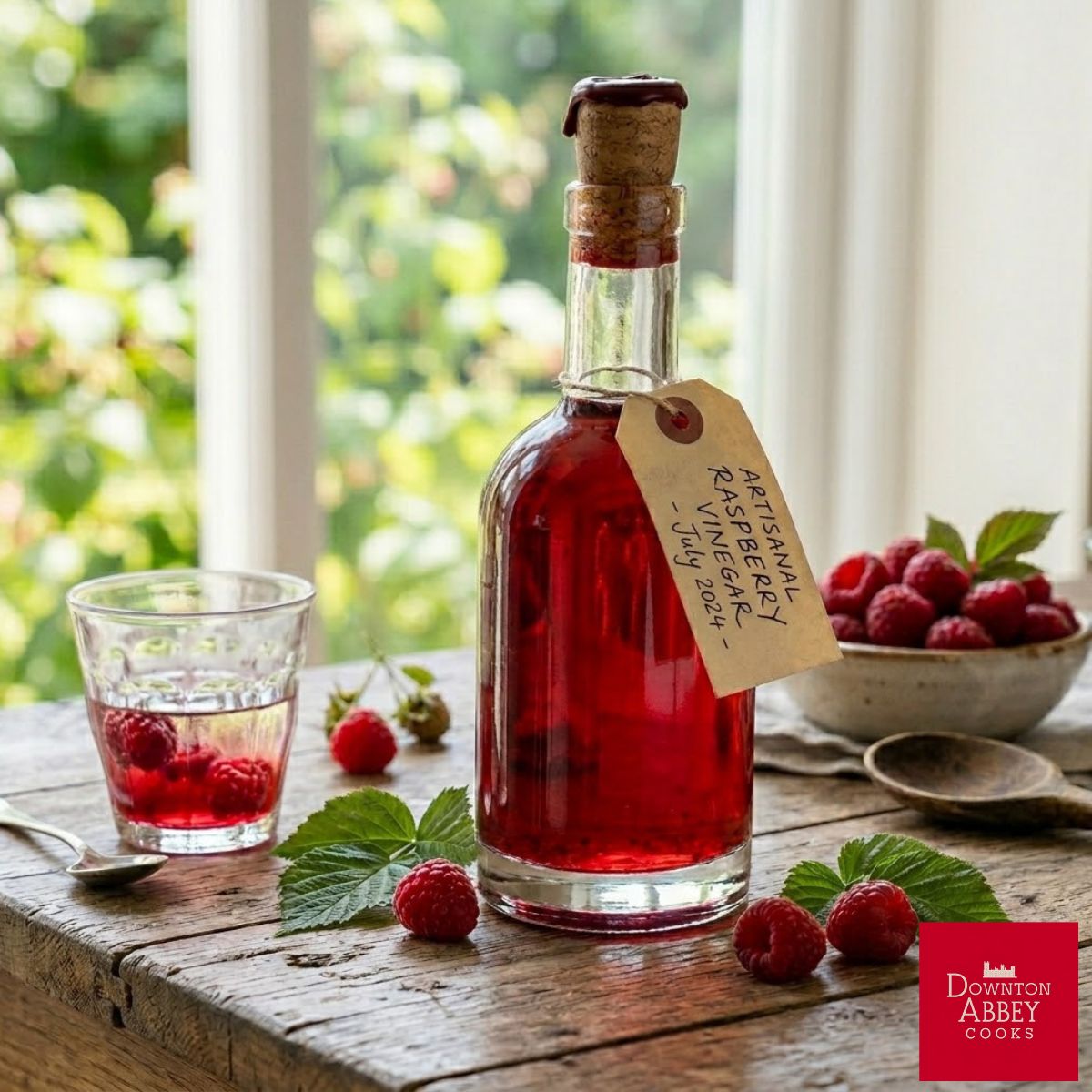
Victorian American Raspberry Vinegar
A cold-steep method from American household manuscripts of the 1840s to 1890s. Richer and more deeply flavoured than shortcuts, because the same vinegar passes through two batches of fruit. Dilute with cold or sparkling water to serve. Also excellent over vanilla ice cream or in a vinaigrette
Servings 8 servings
Ingredients
- 4 cups fresh raspberries divided into two equal portions
- 2 cups white wine vinegar
- 2 cups granulated sugar approximately -- see notes
- Cold or sparkling water to serve

Instructions
First Steep
- Place 2 cups of raspberries in a glass or ceramic bowl. Pour the vinegar over the fruit. Stir gently to bruise the berries slightly. Cover and leave at room temperature for 24 hours. Do not squeeze or crush the fruit -- just let it steep.
Strain and steep again
- After 24 hours, strain the liquid through a fine-mesh sieve into a second bowl, pressing gently to extract the juice. Discard the spent berries. Pour the strained liquid over the second portion of fresh raspberries (the remaining 2 cups). Cover and steep for another 24 hours.
Final strain
- Strain the liquid a second time through a fine-mesh sieve or cheesecloth, pressing well. You should have roughly 2 cups of deep red, intensely flavoured liquid. Discard the spent fruit.
Cook with sugar
- Measure your strained liquid. Add an equal volume of sugar -- so 2 cups of juice gets 2 cups of sugar. Pour into a saucepan, stir over medium heat until the sugar dissolves, then bring to a gentle boil. Simmer for 10 minutes, skimming any foam. The syrup will reduce slightly and thicken.
- Bottle and store
- Remove from heat and cool completely. Pour into clean glass bottles or jars. Seal and refrigerate. Keeps for up to 3 months.
To preserve by water-bath canning
- While the syrup is still hot -- do not let it cool first -- ladle it into sterilized mason jars leaving 1/4 inch headspace. Wipe the rims clean with a damp cloth. Apply new lids and rings fingertip-tight. Process in a boiling water bath for 10 minutes. Remove and leave undisturbed on a folded towel for 12 to 24 hours. Check the seal: the lid should be concave and should not flex when pressed. Any jar that has not sealed properly should go straight to the fridge and be used first. Properly sealed jars keep in a cool dark pantry 12 -36 months. Refrigerate after opening and use within 3 months.
To serve as a drink
- Mix 1 to 2 tablespoons of syrup with cold or sparkling water in a tall glass over ice. Victorian recipes suggest roughly 1 part syrup to 4 parts water, but adjust to taste.
Notes
Why two steeps? American household manuscripts from the 1840s through 1890s consistently used a double or triple-batch method -- the same vinegar passed through two or more fresh batches of fruit before cooking. This concentrates the raspberry flavour far beyond a single steep.
On the vinegar: White wine vinegar is the traditional American choice and keeps the colour bright. Red wine vinegar gives a deeper, more complex flavour. Avoid plain white distilled vinegar -- it's too harsh.
On the sugar: The original method calls for equal weight of sugar to juice. By volume, 2 cups of juice to 2 cups of sugar makes a rich, sweet syrup. If you prefer less sweet, reduce to 1.5 cups sugar per 2 cups juice.
Canning equipment: Use proper mason jars with new lids -- not recycled jam jars. The Ball Blue Book is the authoritative reference if you want to go further into home canning.
Beyond drinks: Excellent as a salad dressing base, drizzled over pound cake or vanilla ice cream, or splashed into sparkling wine for a simple summer cocktail.
Period note: The recipe method comes from the Susan Gilbert household cookbook (1848-1887), University of Iowa Digital Archive. Mrs. Mary J. Lincoln's Boston Cook Book (1884) -- the Gilded Age's defining American kitchen text -- included fruit vinegars among essential summer preparations.