
 Before iced tea ruled the summer table, there was raspberry vinegar.
If you’ve ever wondered what Gilded Age Americans sipped at their Decoration Day picnics, the answer is not lemonade. Well, not only lemonade. The drink that showed up on respectable middle-class picnic menus throughout the 1880s and 1890s was raspberry vinegar — a tart, deeply flavoured syrup diluted with cold water and poured over ice.
It sounds strange. It tastes like summer.
What Is Raspberry Vinegar?
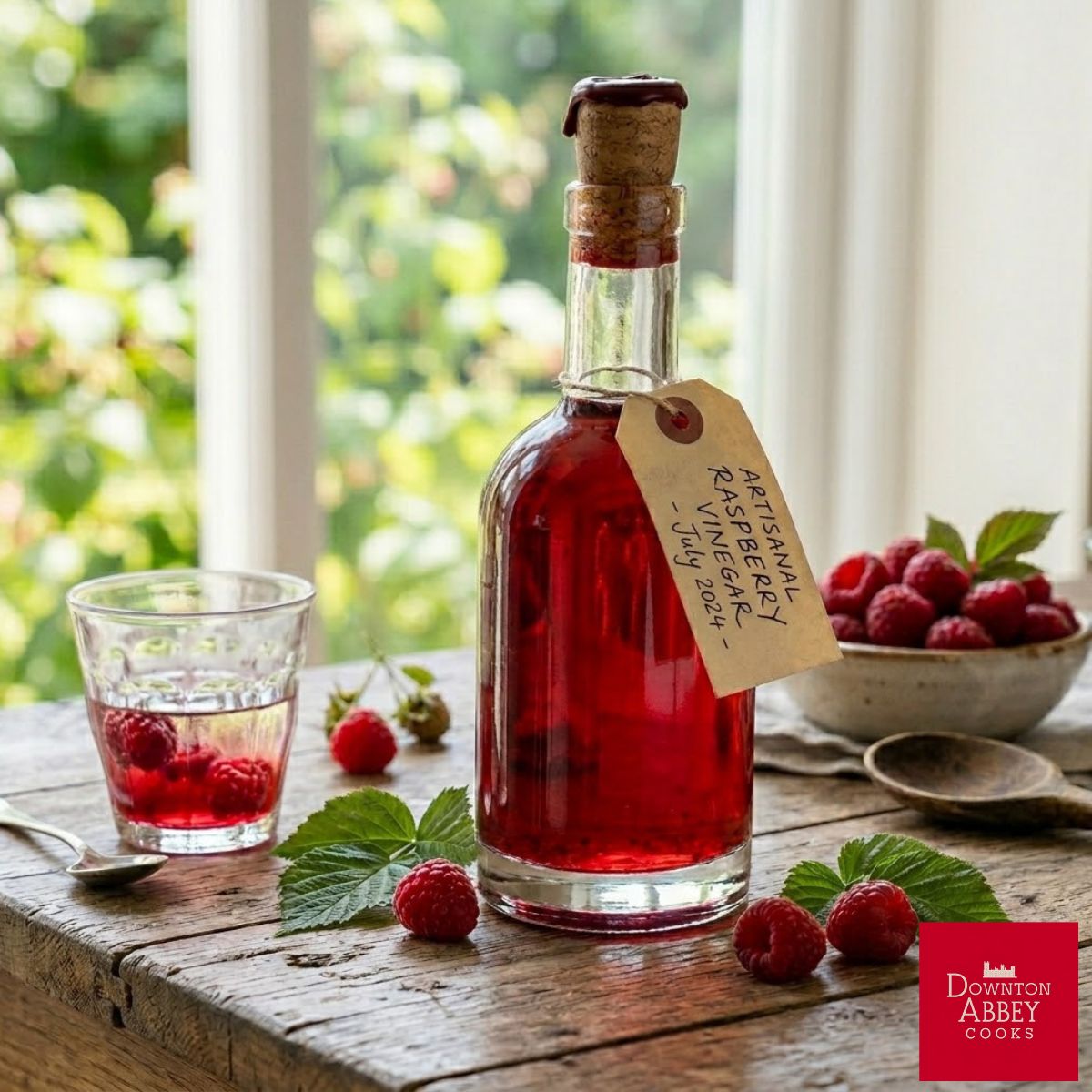
Raspberry vinegar is not a salad dressing, though you can use it as one. It is a concentrated fruit syrup made by steeping fresh raspberries in white wine vinegar, straining the liquid, and cooking it down with sugar. The result is a thick, jewel-coloured syrup that you dilute to taste.
Think of it as a shrub — the drinking vinegar that has made a quiet comeback in craft cocktail bars over the last decade. Same principle, older pedigree.
Victorian households served it the way we serve iced tea: as the default cold drink at outdoor gatherings, picnics, and summer suppers. Non-alcoholic, shelf-stable, and far more interesting than plain water.
Where It Comes From
The recipe has been in American households since at least the 1840s. A handwritten cookbook from 1848, held in the University of Iowa archive, describes the method that American cooks used for the next fifty years: steep vinegar through two batches of fresh raspberries on successive days, then simmer with sugar and bottle cold.
That double-steep is the key. Running the same vinegar through two lots of fruit concentrates the flavour in a way a single steep never quite achieves. It takes two days. It is worth it.
By the Gilded Age — the 1880s and 1890s — raspberry vinegar had become standard summer preparation in American kitchens. Mrs. Mary J. Lincoln, principal of the Boston Cooking School and author of the 1884 cookbook that preceded Fannie Farmer’s, included fruit vinegars among essential summer provisions. Middle-class picnic menus of the era listed it alongside lemonade and ginger beer as the expected non-alcoholic refreshment.
It was, in short, the kombucha of 1885. Tart, a bit surprising, and genuinely good.
Why Make It Now
Fresh raspberries are at their peak in June and July. This recipe uses them at full flavour and preserves that flavour for months. A jar of raspberry vinegar syrup in the fridge gives you a summer drink on demand, a fast salad dressing, a drizzle for vanilla ice cream, and a cocktail mixer that will impress anyone who asks what’s in it.
It also connects you to a genuinely underappreciated piece of American food history. The people who packed it into picnic hampers on Decoration Day in 1888 were doing exactly what we do on Memorial Day weekend: stepping outside, setting down the formality, and eating and drinking together.
Some things don’t need updating.
Victorian American Raspberry Vinegar
Ingredients
- 4 cups fresh raspberries divided into two equal portions
- 2 cups white wine vinegar
- 2 cups granulated sugar approximately -- see notes
- Cold or sparkling water to serve

Instructions
First Steep
- Place 2 cups of raspberries in a glass or ceramic bowl. Pour the vinegar over the fruit. Stir gently to bruise the berries slightly. Cover and leave at room temperature for 24 hours. Do not squeeze or crush the fruit -- just let it steep.
Strain and steep again
- After 24 hours, strain the liquid through a fine-mesh sieve into a second bowl, pressing gently to extract the juice. Discard the spent berries. Pour the strained liquid over the second portion of fresh raspberries (the remaining 2 cups). Cover and steep for another 24 hours.
Final strain
- Strain the liquid a second time through a fine-mesh sieve or cheesecloth, pressing well. You should have roughly 2 cups of deep red, intensely flavoured liquid. Discard the spent fruit.
Cook with sugar
- Measure your strained liquid. Add an equal volume of sugar -- so 2 cups of juice gets 2 cups of sugar. Pour into a saucepan, stir over medium heat until the sugar dissolves, then bring to a gentle boil. Simmer for 10 minutes, skimming any foam. The syrup will reduce slightly and thicken.
- Bottle and store
- Remove from heat and cool completely. Pour into clean glass bottles or jars. Seal and refrigerate. Keeps for up to 3 months.
To preserve by water-bath canning
- While the syrup is still hot -- do not let it cool first -- ladle it into sterilized mason jars leaving 1/4 inch headspace. Wipe the rims clean with a damp cloth. Apply new lids and rings fingertip-tight. Process in a boiling water bath for 10 minutes. Remove and leave undisturbed on a folded towel for 12 to 24 hours. Check the seal: the lid should be concave and should not flex when pressed. Any jar that has not sealed properly should go straight to the fridge and be used first. Properly sealed jars keep in a cool dark pantry 12 -36 months. Refrigerate after opening and use within 3 months.
To serve as a drink
- Mix 1 to 2 tablespoons of syrup with cold or sparkling water in a tall glass over ice. Victorian recipes suggest roughly 1 part syrup to 4 parts water, but adjust to taste.