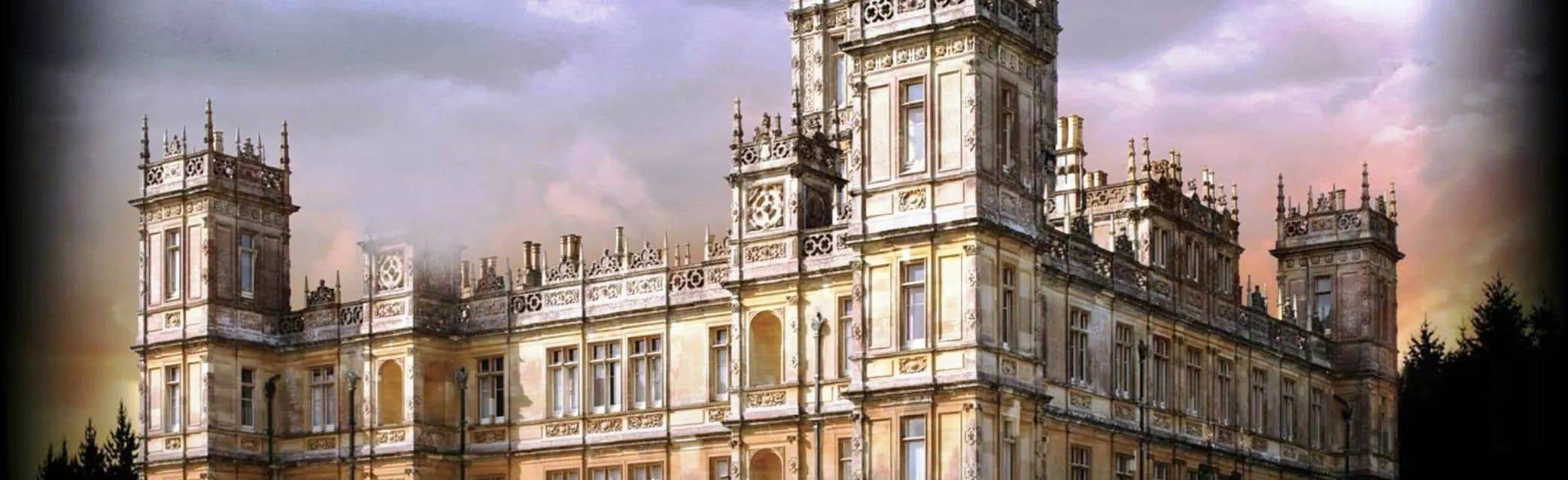
 Downton Abbey places the fictional Crawley family and their estate in the North Riding of Yorkshire, England’s largest historic county, even though the show filmed almost entirely at Highclere Castle in Hampshire, more than 200 miles south. Fictional address aside, the Crawleys’ world runs from 1912 to 1926, and a real Yorkshire household in that era, upstairs or down, would have known the county’s food and its rhythms well: curd tart at Whitsuntide, parkin once the weather turned, Yorkshire pudding served the old way, as a starter, not a side.
Today is Yorkshire Day, the one day a year the county throws itself a party. If you’re a Downton fan, that’s your way in.
Most guides to Yorkshire Day open with the ceremony: the flag, the declaration, the civic leaders in their robes. That’s the surface. The real story is a protest that turned into a tradition, layered on top of a real 18th century battle and a real abolition law. And underneath all of that is food that’s been on Yorkshire tables since long before anyone thought to name a day after the county, including the dishes a kitchen like the Crawleys’ would have made.
Here’s what Yorkshire Day actually is, why it lands on August 1, and four dishes worth making if you want to mark it properly.
What Is Yorkshire Day?
Yorkshire Day is an annual celebration held every August 1 to promote Yorkshire, England’s largest historic county.
Civic leaders read a declaration of the county’s unity at four of York’s medieval gateways, once for each historic Riding, and a ceremonial flag passes from host town to host town each year.
It is not a government holiday. Shops, schools, and offices stay open. Think of it less like a statutory day off and more like a very organized, very sincere regional pep rally.
Why Does Yorkshire Day Fall on August 1?
Two unrelated events share the date, and both mattered enough to Yorkshire that organizers built a holiday around them.
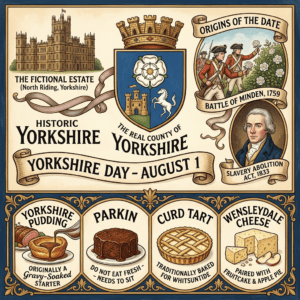
The first is the Battle of Minden, fought in 1759 during the Seven Years’ War. British and allied forces routed the French army in what is now Germany. Soldiers from a Yorkshire regiment picked white roses from hedgerows along the battlefield and wore them in their caps, a tribute to fallen comrades that the regiment kept alive for generations as “Minden Day.”
The second is the Slavery Abolition Act, which received Royal Assent on August 1, 1833 and took effect the following year. The campaign behind it was led in large part by William Wilberforce, a Yorkshire-born member of Parliament who spent decades pushing the bill through.
Neither event has anything to do with the other. They just happen to share a date, and that date is the one Yorkshire’s organizers picked when they needed one.
How a Protest Turned Into a Tradition
Yorkshire Day is younger than most people assume, and it started as a protest, not a celebration.
The Yorkshire Ridings Society held the first one in Beverley in 1975. It was a protest against a 1974 local government reorganization that redrew the county’s boundaries and handed pieces of it to neighboring areas.
The protest stuck. Ten years later, in 1985, Yorkshire’s councils formalized it as an official civic celebration, hosted for the first time in York. Since then, a different town or city takes the host role each year, and the ceremonial flag passes to them, with each council adding its own coat of arms before handing it off.
The centerpiece is still the declaration, read aloud four times at the historic Bars of York, once facing into each Riding and once into the city itself. It is a small, specific ritual for a holiday that did not exist fifty years ago, which is part of what makes it worth knowing about.
Traditional Yorkshire Day Foods (and Where They Actually Came From)
Yorkshire Pudding
Yorkshire pudding did not start as a side dish. It started as a way to not waste fat. Cooks set a simple batter of flour, egg, and milk under a roasting joint of meat so it would catch the dripping fat as it fell, and the dish carried the name “dripping pudding” or “batter pudding” for years before writer Hannah Glasse renamed it in her 1747 cookbook.
For a long time, it was served first, on its own, soaked in gravy, specifically to fill people up before the more expensive cut of meat came out. Some households in Yorkshire still serve it that way. There is no true American equivalent. A popover is the closest cousin in texture, but popovers are usually sweet or plain, never a savory course meant to stretch a meal.
Parkin
Parkin is a dense, sticky gingerbread built on oatmeal instead of flour, sweetened with black treacle, the thick, dark, faintly bitter syrup that sits several shades darker and stronger than American molasses (blackstrap molasses is the closest substitute). It traces back to an older, plainer oatcake called tharf cake, cooked on a griddle over an open fire long before anyone had an oven at home.
Parkin has one rule every Yorkshire baker will tell you: do not eat it fresh. It needs a few days to sit, wrapped and untouched, so the texture turns from crumbly to properly sticky. It is one of the rare baked goods that gets better by being ignored.
Yorkshire Curd Tart
This one goes back to the mid-1600s, when it was traditionally baked for Whitsuntide, the week after Pentecost, and made with beestings: the first, richest milk from a cow that had just calved. The filling was curd cheese, close to what Americans would call farmer’s cheese or dry curd cottage cheese, mixed with butter, eggs, currants, nutmeg, and sometimes a splash of rosewater.
It is easy to mistake for a cheesecake, and it is not one. The texture is softer and less sweet, and the filling holds its shape less than a New York-style cheesecake would. That is the point. It was built from whatever the household had left over from making cheese, not from a recipe designed to impress. My Yorkshire Curd Tart
Wensleydale Cheese
Most people outside Yorkshire know this cheese from Wallace and Gromit, but it predates the claymation duo by about 800 years. French Cistercian monks who settled in the region in 1150 made the first versions, and the cheese has stayed a Yorkshire staple ever since, crumbly, mild, and traditionally paired with fruitcake or apple pie rather than eaten on its own.
Yorkshire Day FAQ
Is Yorkshire Day a public holiday?
No. Businesses, schools, and government offices operate as normal. It is a civic and cultural celebration, not a statutory day off.
Why do people wear a white rose on Yorkshire Day?
The tradition comes from the Battle of Minden in 1759, when Yorkshire soldiers wore white roses picked from the battlefield in tribute to fallen comrades. Some regiments and civic groups still wear one on August 1, though the practice has faded in recent decades.
What food is Yorkshire most famous for?
Yorkshire pudding is the county’s best-known export by a wide margin, though Wensleydale cheese runs a close second internationally, largely thanks to Wallace and Gromit.
Did Downton Abbey actually film in Yorkshire?
Mostly no. The main house scenes were filmed at Highclere Castle in Hampshire. Some location work, including scenes in the 2019 film, used Wentworth Woodhouse, a real estate in Yorkshire.
The Bottom Line
Yorkshire didn’t wait for a national holiday to prove it was different. It built its own case: a battle, an abolition law, a protest, and a table full of food that never needed a special occasion to be worth making. August 1 just gave it a name.