
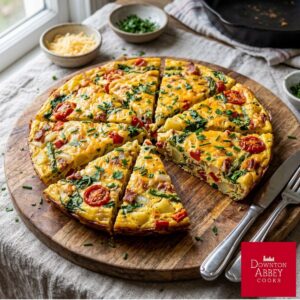
 Eggs in the fridge. Half an onion. A block of cheddar going hard at the edges. That is a frittata waiting to happen, and it is one of the most useful things you can learn to cook without a recipe.
Below is the full method, the ratio that makes it foolproof, and an answer to a question a few Downton Abbey fans have asked me: would Mrs. Patmore have ever put one of these on the table.
What a Frittata Actually Is
A frittata is an Italian egg dish, best described as an open-faced omelette. The difference is in the method, not just the shape. In a French or American omelette, you add the filling to eggs that are already mostly cooked, then fold it shut. In a frittata, the add-ins go into the raw egg mixture before it ever hits the pan, and the dish cooks low and slow until it sets all the way through, more like a crustless quiche than a folded omelette.
That slower cook is what gives a frittata its texture. It also means you can beat the eggs hard beforehand to work in air, which creates the fluff.
Where the Frittata Comes From
The word comes from the Italian friggere, meaning “to fry.” It originally described almost any egg dish cooked in a pan, not one specific technique. Naples has the strongest regional claim on the dish, and some food historians trace egg dishes of this general type back to Roman-era cooking in Italy, though the early history gets thin the further back you go.
Here is the detail that matters for a Downton Abbey audience: outside of Italy, frittata was treated as more or less interchangeable with “omelette” for a very long time. The dish didn’t become defined as its own distinct technique in English-language kitchens until food writer Elizabeth David laid it out clearly in her 1954 book Italian Cooking. That is decades after Downton’s world ends.
Would Frittata Have Been Served at Downton Abbey? Short Answer: Not by That Name
 An Edwardian country house breakfast was not a light affair. A formal spread routinely included toast, muffins, coffee, and, as period accounts put it, “omelets and other preparations of eggs.” Mrs. Beeton’s Book of Household Management, the reference book every well-run English kitchen leaned on well into the 1920s, claimed over two hundred ways of dressing eggs alone.
So a kitchen like Mrs. Patmore’s absolutely turned out savoury, egg-based dishes loaded with ham, cheese, and whatever the kitchen garden had going. She would not have called it a frittata. That word, and the specific stir-it-all-in-raw technique behind it, had not crossed into English kitchens yet. She would have called it a savoury omelette, or served individual baked eggs in a ramekin, sometimes called shirred eggs, which does the same basic job.
So the honest answer is both no and yes. No Downton menu card ever read “frittata.” But the instinct behind the dish, eggs plus whatever is on hand, cooked simply and served without fuss, was already very much at home in an English kitchen. Only the name was missing.
How to Make a Great Frittata
Once you know the ratio, you stop needing a recipe. This is the version I use for a standard 10-inch, 8-egg frittata, and it scales up or down cleanly.
The Core Ratio
- 2 eggs per person
- 1 tablespoon of milk or cream per 2 eggs
- 1 cup of cooked add-ins per 8 eggs, measured after cooking
That add-in limit matters more than people expect. Go past a cup for 8 eggs and the egg can no longer bind everything together. The frittata looks fine coming out of the oven and then falls apart the moment you cut it.
Match the Pan to the Egg Count
The rule of thumb is about 1 egg per inch of pan diameter. Too big a pan gives you a thin, dry disc. Too small and the middle stays raw while the edges overcook.
|
Pan Size |
Eggs |
Bake Time at 375°F |
|
8 inch |
6 |
8 to 10 minutes |
|
10 inch |
8 |
10 to 12 minutes |
|
12 inch |
12 |
12 to 15 minutes |
The Method, Step by Step
- Cook every add-in before it goes anywhere near the eggs. Raw vegetables release water as they bake, which can make the whole dish soggy.
- Whisk the eggs hard for 30 to 45 seconds, until pale and slightly frothy. This is where the fluff comes from, not from the oven.
- Start the frittata on the stovetop in an oven-safe skillet, letting the edges set while the center stays loose.
- Finish it in a 375°F oven for 10-12 minutes or until the center barely wobbles when you nudge the pan. Do not wait for it to puff and brown, or it will overbake.
- Let it rest in the pan for a few minutes before you slice. It keeps cooking slightly as it sits, and cutting too early gives you a wet centre.
What Usually Goes Wrong
- Dense, flat result: the eggs were not whisked hard enough before cooking.
- Watery or soggy: raw vegetables went in instead of cooked ones.
- Falls apart when sliced: too many add-ins for the amount of egg.
- Rubbery and dry: it stayed in the oven too long after the center set.
Frittata Questions, Answered
What is the difference between a frittata and an omelette?
An omelette is filled after the eggs are mostly cooked and then folded shut. A frittata has its add-ins mixed into the raw eggs from the start and cooks slowly, unfolded, until it sets all the way through.
Can you make a frittata without milk?
Yes. Eggs on their own make a firmer, more solidly eggy frittata. Water works as a substitute too, and many restaurant cooks actually use it.
Why is my frittata dense instead of fluffy?
Usually, the eggs weren’t whisked hard enough before cooking. A quick stir combines them. A full 30 to 45 seconds of real whisking works air in, which creates lift.
What size pan should I use for a frittata?
Use roughly 1 egg per inch of pan diameter: 6 eggs for an 8-inch pan, 8 eggs for a 10-inch pan, 12 eggs for a 12-inch pan.
Can you make a frittata in an air fryer?
Yes, in any pan that fits the basket. A 6-inch pan holds about 4 eggs and bakes at 325°F for 12 to 15 minutes. Cook all add-ins separately first, since there is no stovetop step in an air fryer.
How long does a frittata keep in the fridge?
Three days, covered. It is good cold and arguably better at room temperature.
The Final Word
Frittata is a Neapolitan name for a very old idea: eggs plus whatever is on hand, cooked simply and served without ceremony. Downton’s kitchen ran on the exact same instinct, just under a different name and a French or English one at that. Learn the ratio, not a recipe, and you will find a use for it just as often as Mrs. Patmore would have.
How to Make A Great Frittata
Equipment
- 1 10 inch skillet
Ingredients
- 8 large eggs
- 1/4 cup whole milk or cream (60 ml
- 1/2 cups grated cheese (100 g) old cheddar, Gruyère, or Parmesan
- 1 medium onion thinly sliced or diced
- 1 cups cooked add-ins see notes
- 2 tbsp. butter
- 0.5 tsp. salt
- 0.3 tsp. black pepper
- 2 tbsp. chopped fresh chives or parsley

Instructions
- Heat the oven and prep add-ins: Heat the oven to 375°F (190°C) with the rack in the middle. Have 1 cups cooked add-ins (see notes) cooked, cooled, and cut into pieces about 1 cm (half inch). Drain or squeeze out any liquid.
- Soften the onion: Melt 2 tablespoons butter in a 25 cm (10 inch) oven-safe skillet over medium heat. Add 1 medium onion, thinly sliced and cook until soft and golden at the edges. Cast iron or heavy nonstick both work.
- Whisk the eggs:While the onion cooks, whisk 8 large eggs with 60 milliliters whole milk or cream, 0.5 teaspoons salt, 0.3 teaspoons black pepper, and about two thirds of 100 grams grated cheese (old cheddar, Gruyère, or Parmesan). Whisk until the yolks and whites are fully combined and slightly frothy.
- Add the add-ins: Scatter 1 cup cooked add-ins (see notes) evenly over the onions in the pan and spread them into a single layer. Do not stir them into the eggs. Layering them in the pan keeps them from sinking to the bottom.
- Set the base: Pour the egg mixture over everything and give the pan a gentle shake to settle it. Let it sit undisturbed until the edges look set but the centre is still loose. 3 to 4 minutes.
- Bake: Scatter the remaining 100 grams grated cheese (old cheddar, Gruyère, or Parmesan) over the top and move the pan to the oven. Bake 10 -12 minutes until the centre is just set and barely jiggles when you nudge the pan. Do not wait for it to puff and brown or it will be dry.
- Rest and serve: Let it rest in the pan. Loosen the edge with a spatula, slide it onto a board, and top with 2 tablespoons chopped fresh chives or parsley. Cut into wedges.
Notes
- Sautéed mushrooms, squeezed of liquid
- Roasted red pepper, chopped
- Diced cooked potato
- Spinach or chard, wilted and wrung out in a tea towel
- Blanched asparagus or broccoli, cut small
- Crumbled bacon, sausage, or diced ham
- Roasted cherry tomatoes Cut everything to about 1 cm (half inch). Big pieces create weak spots where the slice breaks. Watery vegetables are the usual failure. Zucchini and fresh tomato need to be salted, drained, and cooked down first, or left out. The base ratio: 2 eggs per person, 15 ml (1 tbsp) milk per 2 eggs, 250 ml (1 cup) add-ins per 8 eggs. Keeps three days covered in the fridge. Good cold, better at room temperature.
How to Make A Great Frittata
Equipment
- 1 10 inch skillet
Ingredients
- 8 large eggs
- 1/4 cup whole milk or cream (60 ml
- 1/2 cups grated cheese (100 g) old cheddar, Gruyère, or Parmesan
- 1 medium onion thinly sliced or diced
- 1 cups cooked add-ins see notes
- 2 tbsp. butter
- 0.5 tsp. salt
- 0.3 tsp. black pepper
- 2 tbsp. chopped fresh chives or parsley
Instructions
- Heat the oven and prep add-ins: Heat the oven to 375°F (190°C) with the rack in the middle. Have 1 cups cooked add-ins (see notes) cooked, cooled, and cut into pieces about 1 cm (half inch). Drain or squeeze out any liquid.
- Soften the onion: Melt 2 tablespoons butter in a 25 cm (10 inch) oven-safe skillet over medium heat. Add 1 medium onion, thinly sliced and cook until soft and golden at the edges. Cast iron or heavy nonstick both work.
- Whisk the eggs:While the onion cooks, whisk 8 large eggs with 60 milliliters whole milk or cream, 0.5 teaspoons salt, 0.3 teaspoons black pepper, and about two thirds of 100 grams grated cheese (old cheddar, Gruyère, or Parmesan). Whisk until the yolks and whites are fully combined and slightly frothy.
- Add the add-ins: Scatter 1 cup cooked add-ins (see notes) evenly over the onions in the pan and spread them into a single layer. Do not stir them into the eggs. Layering them in the pan keeps them from sinking to the bottom.
- Set the base: Pour the egg mixture over everything and give the pan a gentle shake to settle it. Let it sit undisturbed until the edges look set but the centre is still loose. 3 to 4 minutes.
- Bake: Scatter the remaining 100 grams grated cheese (old cheddar, Gruyère, or Parmesan) over the top and move the pan to the oven. Bake 10 -12 minutes until the centre is just set and barely jiggles when you nudge the pan. Do not wait for it to puff and brown or it will be dry.
- Rest and serve: Let it rest in the pan. Loosen the edge with a spatula, slide it onto a board, and top with 2 tablespoons chopped fresh chives or parsley. Cut into wedges.
Notes
– Sautéed mushrooms, squeezed of liquid
– Roasted red pepper, chopped
– Diced cooked potato
– Spinach or chard, wilted and wrung out in a tea towel
– Blanched asparagus or broccoli, cut small
– Crumbled bacon, sausage, or diced ham
– Roasted cherry tomatoes Cut everything to about 1 cm (half inch). Big pieces create weak spots where the slice breaks. Watery vegetables are the usual failure. Zucchini and fresh tomato need to be salted, drained, and cooked down first, or left out. The base ratio: 2 eggs per person, 15 ml (1 tbsp) milk per 2 eggs, 250 ml (1 cup) add-ins per 8 eggs. Keeps three days covered in the fridge. Good cold, better at room temperature.