
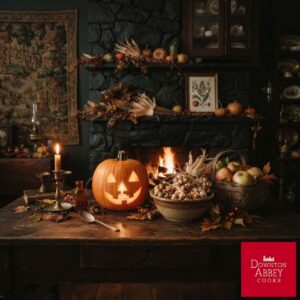
Before trick-or-treating, Halloween was a party. Here is what Gilded Age hosts served, the fortune games their guests played, and the popcorn balls you can make this weekend.
Halloween falls on a Saturday this year. The Gilded Age returns to HBO the very next night. That makes this the perfect weekend to throw a Halloween party the way New York did in the 1880s: by candlelight, with apples, nuts, a little fortune-telling and a big bowl of popcorn balls.
The short answer: A Victorian or Gilded Age Halloween was an evening party at home, not a night of trick-or-treating. Hosts served apples, nuts, doughnuts, popcorn balls, candied fruit, ice cream and cake. Guests played games that claimed to predict love, marriage and money.
What did a Victorian Halloween party look like?
Halloween came to America mostly with Irish immigrants. Millions arrived after the potato famine of the 1840s, bringing the holiday’s customs with them. By the late 1800s, Halloween had become a favourite excuse for a party.
These were parties for young people, and they were meant to be fun. The Molly Brown House Museum in Denver notes that Halloween, unlike Christmas, was a night to keep things informal. Ladies’ magazines spread the ideas. Demorest’s magazine ran “A Nutting Party and a Halloween Frolic” in 1887, just one year after Season 4 of The Gilded Age is set.
Hosts decorated with what the harvest gave them. Halloween historian Lesley Bannatyne, speaking to Milk Street, describes rooms hung with apples and horseshoes, chrysanthemums on the tables, and candles and jack-o’-lanterns for light. Some hostesses hung strips of newspaper from the ceiling so guests would feel something brush their faces in the dark. Cheap, simple and just spooky enough.
What food was served at a Victorian Halloween party?
The menu was harvest food you could eat standing up. The Molly Brown House Museum lists doughnuts, popcorn balls, apples, nuts, candied fruit, ice cream and cakes as typical party fare.
Irish families added their own dishes. Colcannon, mashed potatoes with cabbage or kale, was a Halloween supper in Ireland long before it became a St. Patrick’s Day side. Barmbrack, a speckled fruit bread, came with a fortune baked inside. Soul cakes, the spiced cookies once handed to “soulers” at the door, are older still.
And there was candy corn. Invented in the 1880s, it’s a true Gilded Age sweet. You can read the history of candy corn here.
If Cora, the future Countess of Grantham, went to a Halloween party as a girl in Cincinnati, this is very likely what she ate. She grew up on iced tea too.
Which fortune-telling games did Victorians play on Halloween?
Fortune-telling was the main event. Most of the games circled one question: who will I marry? Victorian hostesses borrowed many of them from Robert Burns’s 1785 poem “Halloween,” which came with notes explaining how the Scots played each one.
Could be the hit of the party. A current national survey reveals that millennials and Gen Z adults are experiencing dating app burnout and turning to manifestation, psychics, astrology, tarot cards, or love spells to navigate their romantic lives.
Four you can play this weekend:
- The fortune cake. Bake small tokens into a cake or a barmbrack. The one in your slice predicts your year. The Clarke Historical Museum lists a ring for marriage, a coin for wealth, a key for a journey and a thimble for staying single. Wrap each token in parchment and warn your guests before they bite.
- Snap-apple. Hang apples from strings and try to bite them with your hands behind your back. Americans in the 1800s kept up the old British custom of Snap Apple Night.
- The apple peel. Peel an apple in one long strip and toss it over your shoulder. The shape it lands in is said to be the first letter of your future spouse’s name.
- Burning nuts. Name two nuts after a couple and set them near the fire. If they burn side by side quietly, the match will last. If one pops away, it won’t. Keep this one to the fireplace and the grown-ups.
Why were popcorn balls a Halloween party favourite?
Popcorn balls were cheap, filling and easy to make by the dozen. Popcorn cost pennies, and every kitchen had molasses. The earliest known recipe for “Pop Corn Balls” appeared in 1861, in E. F. Haskell’s The Housekeeper’s Encyclopedia, tucked between two recipes for molasses candy, according to Tasting Table.
They also travelled well. You could wrap one in paper and hand it to a guest on the way out the door. That habit outlived the parlor parties. By the 1950s, popcorn balls were a standard treat for trick-or-treaters.
The molasses gives these a deep, toffee-like flavour that corn syrup versions can’t match. They are crisp on the outside and chewy in the middle. Make one batch and you will understand why they lasted a hundred years.
How do you make old-fashioned popcorn balls?
The method is simple. The only tool that matters is a candy thermometer.
- Cook the syrup to 260°F, the hard-ball stage. Any lower and the balls fall apart. Any higher and they turn brittle enough to worry your dentist.
- Pour the hot syrup over the popcorn right away and toss it fast with a buttered spatula.
- Wait two or three minutes, butter your hands, and press the popcorn into balls about the size of a small apple.
Kids can help wrap them. Leave the shaping to the adults, because hot sugar burns.
How to host a Gilded Age Halloween party this weekend
You don’t need a Fifth Avenue mansion. You need an evening, a few friends and one good table.
- Set the scene. Apples in bowls, chrysanthemums in jars, candles and a jack-o’-lantern or two. Turn the overhead lights off.
- Keep the menu to finger food. Popcorn balls, a barmbrack with tokens, a plate of soul cakes, a bowl of nuts and candy corn, and hot cider. Add a pot of colcannon if people are staying for supper.
- Pick two games. The fortune cake and the apple peel work in any living room. Save snap-apple for a group that doesn’t mind getting sticky.
- Send everyone home with a popcorn ball. Wrapped in waxed paper and tied with string, it is the 1880s party favor.
- Keep Sunday night free. Season 4 of The Gilded Age premieres November 1 at 9 p.m. ET on HBO.
Frequently asked questions
Did Victorians go trick-or-treating?
No. In the Victorian era, costumes and trick-or-treating were not yet part of Halloween, according to Victorian Voices. People celebrated with parties and fortune-telling games at home.
When was the candy apple invented?
Newark candy maker William W. Kolb is credited with the red candy apple in 1908. He dipped apples in red cinnamon candy for a Christmas window display, and sold them for a nickel each, according to Wikipedia’s account drawn from the Newark News. That makes it an Edwardian sweet, from the Downton Abbey years.
Can I make popcorn balls ahead of time?
Yes. Wrapped airtight, they keep 3 to 4 days at room temperature. For a Saturday party, make them Wednesday or Thursday.
Why did my popcorn balls fall apart?
The syrup didn’t get hot enough. Cook it to 260°F. If they came out rock hard, the syrup went too far.
What is barmbrack?
An Irish fruit bread traditionally baked with tokens at Halloween. The token in your slice tells your fortune. Here is my barmbrack recipe.
When does The Gilded Age Season 4 premiere?
Sunday, November 1, 2026, at 9 p.m. ET on HBO, streaming on HBO Max.
A final thought
A Gilded Age Halloween was never about fright. It was about a warm room, good company and a little hope for the year ahead. Bake something, play a silly game, and send your guests home with a popcorn ball. Great food has a history, and this one tastes just as good as it did in 1886.
Next week, I’ll take you inside a formal New York dinner from 1886, course by course, just in time for the Season 4 premiere.
Sources
- Molly Brown House Museum, Halloween Traditions
- Milk Street, What it was like to have a Victorian Halloween (interview with Lesley Bannatyne)
- Victorian Voices, Halloween, Thanksgiving and Other Fall Festivals
- Clarke Historical Museum, Victorian Halloween parlor traditions
- Food Republic, What Americans Ate on Halloween in the 1800s
- Tasting Table, The Old-Fashioned Popcorn Snack
- Wikipedia, Candy apple
- TVLine, The Gilded Age Season 4 premiere date
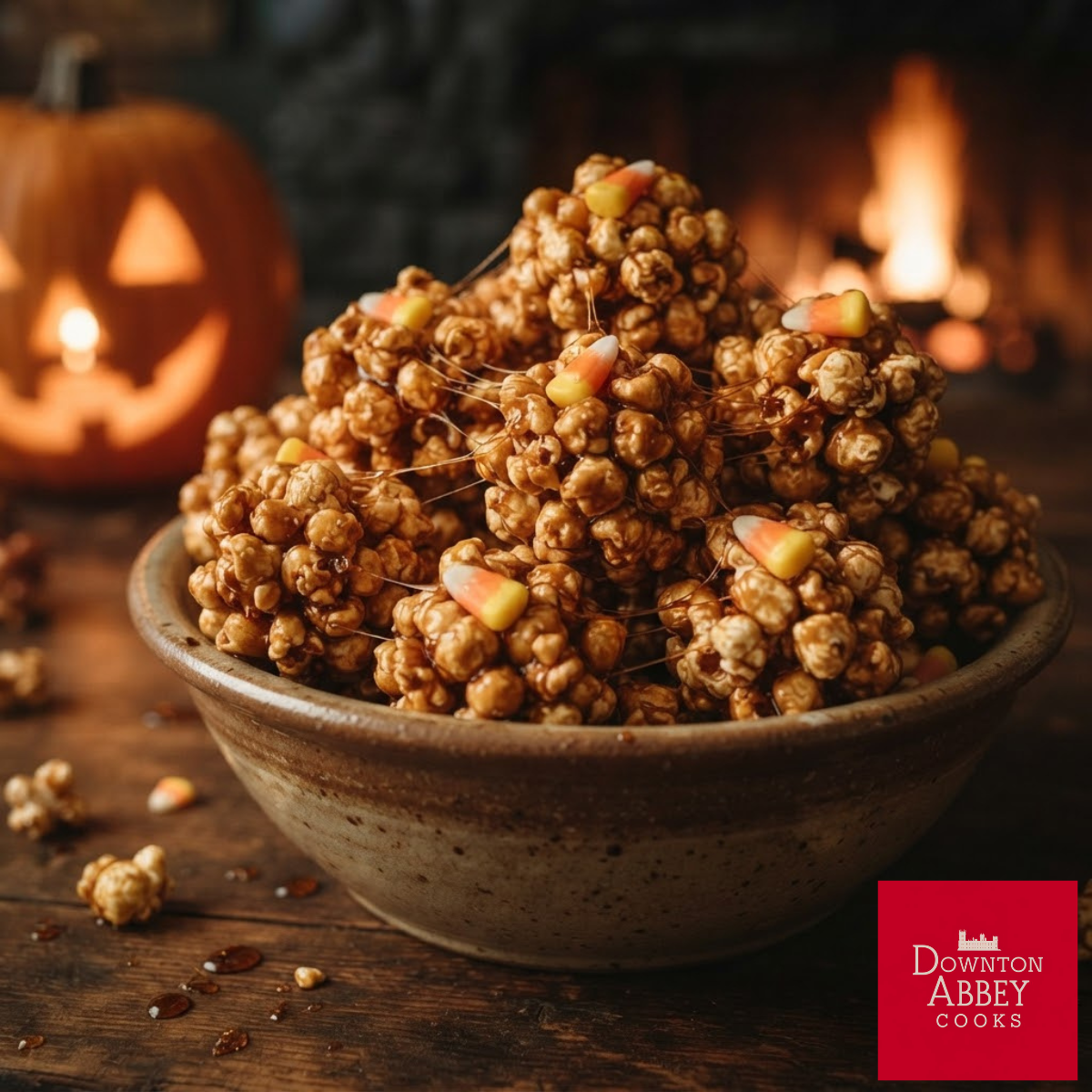
Old-Fashioned Molasses Popcorn Balls
Equipment
- 1 candy thermometer
- large heavy saucepan
- very large bowl
- 1 silicone spatula
- 1 parchment or waxed paper
Ingredients
- 14 cups plain popped popcorn unbuttered (from about 1/2 cup kernels)
- 1 cup granulated sugar
- 1/2 cup unsulphured molasses not blackstrap
- 1/3 cup water
- 1 tsp. white vinegar
- 2 tbsp. butter plus more for your hands
- 1/2 tsp. salt

Instructions
- Instructions
- Put the popcorn in a very large buttered bowl and pick out any unpopped kernels. Line a baking sheet with parchment.
- In a heavy saucepan, stir together the sugar, molasses, water and vinegar. Cook over medium heat, stirring, until the sugar dissolves.
- Clip on a candy thermometer. Boil without stirring until the syrup reaches 260°F (hard-ball stage), about 10 to 12 minutes.
- Take the pan off the heat. Stir in the butter and salt until melted. It will foam up; that is normal.
- Pour the syrup slowly over the popcorn, tossing with a buttered spatula until it is evenly coated.
- Let stand 2 to 3 minutes, until you can handle it. Butter your hands and press the popcorn firmly into 3-inch balls. Set them on the parchment.
- Cool completely, about 20 minutes, then wrap each ball in waxed paper or cellophane.
Notes
• Humid day? Wrap the balls as soon as they cool, or they turn sticky.
• No thermometer? Drop a little syrup into a glass of cold water. At the right stage it forms a firm ball that holds its shape.
• A Gilded Age touch: press a few pieces of candy corn into each ball before it sets