
 What Is Chive Blossom Vinegar?
It is exactly what it sounds like: white wine or champagne vinegar infused with fresh chive blossoms. Capturing the essence of the blossoms in vinegar is a way to preserve their unique flavour long after their season has passed.
The result is not sharp or strongly oniony. The flavour is gentle and savoury, with the mild allium quality of the chive underneath the vinegar’s acidity. The longer you leave it, the more colour and flavour you get.
That colour alone makes it worth making. After two weeks, the vinegar turns a deep rose pink. Put it in a nice bottle, and it looks like something you’d pay twelve dollars for at a farmers’ market.
A Very Old Idea
Infusing vinegar with herbs from the kitchen garden is not a new technique. Herb-infused vinegars were well established by the 18th and 19th centuries, particularly in French kitchens, where chives were considered part of the essential backbone of seasoning alongside parsley, tarragon, and chervil.
Mrs. Beeton’s name became synonymous with authority on Victorian cooking and household management, and the pantry she described was one where nothing seasonal was wasted. Preserving the summer’s harvest into vinegars, pickles, and condiments was simply good housekeeping. The cook at a house like Downton Abbey would have understood instinctively that a jar of infused vinegar started in May could still be useful in November.
Chive blossom vinegar fits squarely into that tradition. It requires no special equipment, no canning knowledge, and no particular skill. Just blossoms, vinegar, time, and a clean jar.
What You Can Do With It
This is not a specialty ingredient you make once and forget at the back of the cupboard. It earns its place.
Salad dressings. This is the most obvious use, and also the best starting point. Replace the white wine vinegar in any simple vinaigrette and taste the difference. The savoury depth it adds is noticeable without being distracting.
Drizzled over vegetables. Try it over roasted vegetables or potato salad, or stirred into ricotta and served on toast.
As a marinade base. It works well for chicken. Marinate for 30 minutes to an hour before cooking.
In cocktails. Add a splash to a gin and tonic for a vegetal quality, or stir a tablespoon into a Bloody Mary for a mild, oniony lift.
As a gift. The colour is striking and it keeps well. A pretty bottle with a handwritten label is a genuinely useful hostess gift, not a throwaway one.
A Few Things Worth Knowing Before You Start
Use a clear vinegar. Champagne vinegar or white wine vinegar works best. Avoid dark vinegars. The pink colour is the point. Distilled white vinegar works in a pinch, though the flavour can be a little sharp.
Avoid metal lids if you can. Vinegar corrodes metal over time. Use a plastic lid, a cork, or place a piece of parchment between the jar and the metal lid before sealing.
Use fresh blossoms at peak bloom. Harvest when the flowers are fully open but before they start to fade or dry on the stem. Rinse carefully and soak briefly in cold water to dislodge any insects hiding in the florets.
Be patient. A slow, cold infusion over two weeks produces a richer, better result than heating the vinegar to speed things up. It is worth the wait.
Storage. Properly strained and bottled, chive blossom vinegar keeps for up to a year in a cool, dark cupboard.
One Last Thing
The blossoms are fleeting. The vinegar is not. Two weeks of patience and you have something useful, beautiful, and entirely made from your own garden. That is the kind of kitchen economy the Edwardians understood, and we are slowly remembering.
If you make it, leave a comment below. And if you find a use for it that I haven’t listed here, I’d like to hear about that too.
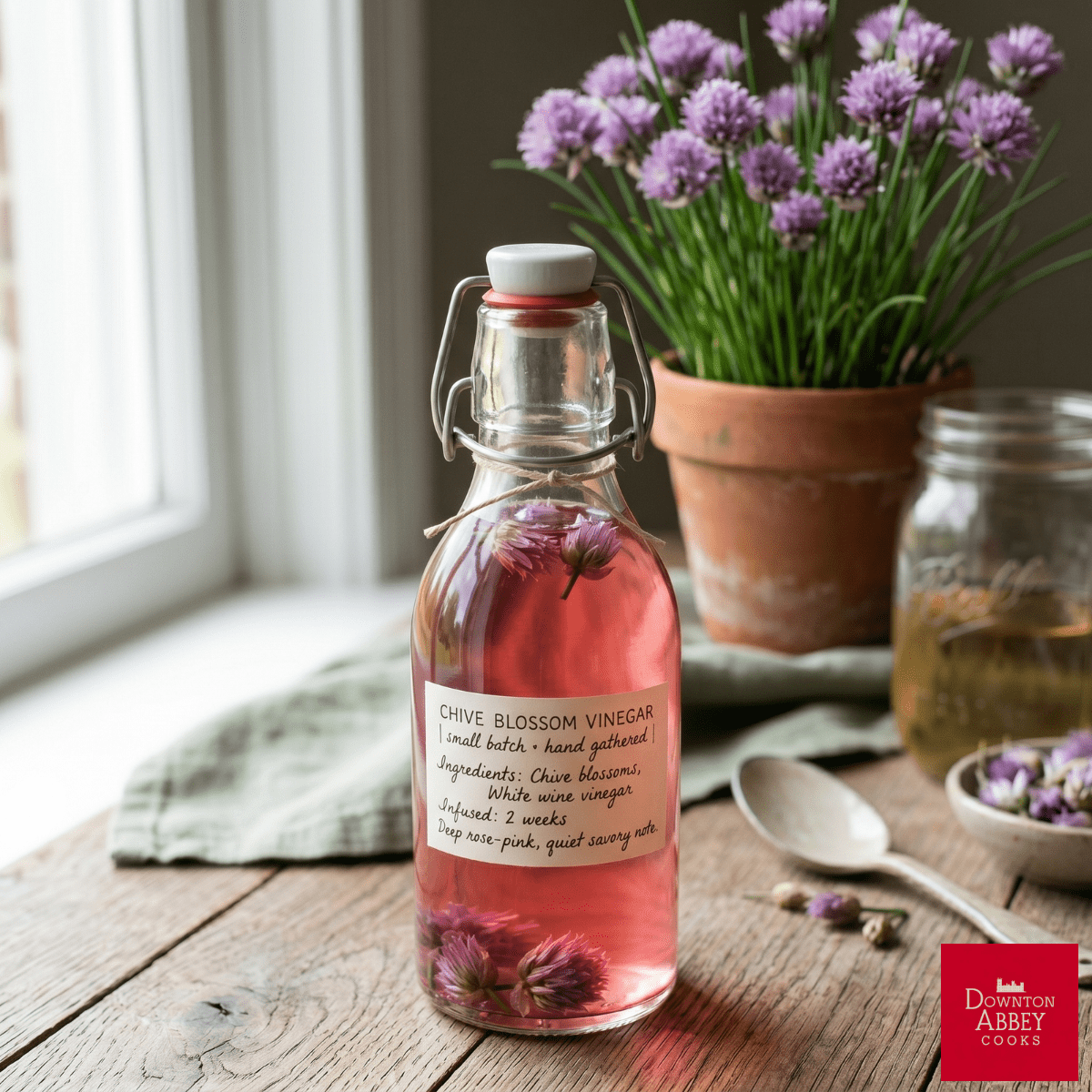
Chive Blossom Vinegar
Ingredients
- 1 cup fresh chive blossoms rinsed and dried
- 2 cups cups white wine vinegar or champagne vinegar

Instructions
- Clean the blossoms: Rinse 1 cup fresh chive blossoms, rinsed and dried under cool running water. Soak in a bowl of cold water for 5 minutes to dislodge any insects. Drain and pat dry gently with a clean towel.
- Combine and seal: Pack the blossoms into a clean glass jar. Pour 2 cups of white wine vinegar or champagne vinegar over top until the blossoms are completely submerged. Press down gently if needed. Seal the jar.
- Infuse: Store in a cool, dark place for 2 weeks. The vinegar will gradually turn pink. Taste at the 2-week mark. Leave longer for a stronger flavour.
- Strain and bottle: Strain the vinegar through a fine mesh sieve into a clean jar or bottle. Discard the spent blossoms. Seal and store.