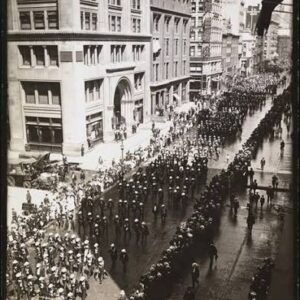
The first Labor Day was Tuesday, September 5, 1882, in New York City. Roughly 10,000 to 20,000 workers gave up a day of pay to march from City Hall Park up Broadway and Fifth Avenue, then gathered at Wendel’s Elm Park at 92nd Street and Ninth Avenue for a picnic. The U.S. Department of Labor records lager beer kegs mounted in every conceivable place. Nobody that day called it Labor Day.
Key facts
- Date: Tuesday, September 5, 1882
- Organizer: the Central Labor Union of New York
- Route: City Hall Park, up Broadway, past reviewing stands at Union Square, across 17th Street and up Fifth Avenue, ending at 42nd Street
- Picnic: Wendel’s Elm Park, Ninth Avenue at 92nd Street, the largest beer garden in the city
- Turnout: press estimates ran from 12,500 to 20,000; grand marshal William McCabe put it at nearly 4,000
- Cost to marchers: about two dollars, a full day’s wage for a ten to twelve hour shift
- Federal holiday: 1894, signed by President Grover Cleveland after the Pullman strike
Monday is Labor Day. For most of us that means a grill, a cooler, and the last decent tomato of the season.
The first one was different. It fell on a Tuesday, it cost the marchers a day of pay, and it finished with a beer garden picnic at 92nd Street.
It also happened in 1882. Same year, same city, same season that The Gilded Age opens. While Bertha Russell was forcing her way into a society that did not want her, thousands of working New Yorkers walked up Fifth Avenue past the houses of the people who ran it.
Here is what happened, what they ate, and the one dish worth putting on your table Monday.
The parade that almost did not happen
The plan came out of the Central Labor Union, an umbrella group for workingmen around New York. At a meeting on Sunday, May 14, 1882, the minutes record a proposal for a monster labor festival that all workingmen could take part in, early in September. Matthew Maguire, the union’s secretary, is usually credited with the idea. Peter J. McGuire of the carpenters has also been credited. The names sound alike, and historians have never fully settled it.
They chose Tuesday, September 5, to coincide with the Knights of Labor convention meeting in the city. A workday, on purpose. The standard wage was about two dollars for a ten or twelve hour day, six days a week, so marching cost every man in the line real money. That was the point.
It nearly collapsed. Grand marshal William McCabe arrived at City Hall Park at half past eight and found nothing ready. His own local printers, which had promised a band, had not turned out a single member. He went to the union office and talked twenty-five or thirty printers into coming. Idle men on the sidewalk stood around enjoying his difficulty.
Then, close to ten o’clock, two hundred jewellers arrived from Newark with a brass band playing a tune from the newest Gilbert and Sullivan. McCabe gave the order, and the parade moved up Broadway.
After a mile, four hundred bricklayers swung in from a side street. After that, every side street seemed to hold another union waiting to fall in. The pianomakers brought a wagon with a piano on it, and a pianomaker playing it. The horseshoers wore silk aprons with red horseshoes woven into them.
How many marched depends on who counted. The Sun said 12,500. The World said 14,000. The Irish World said 15,000 to 20,000. McCabe himself, in the best position to count and the worst position to exaggerate, later put it at nearly 4,000.
The route: up Fifth Avenue, past Delmonico’s
The route is what makes this a Gilded Age story and not only a labor story.
After the reviewing stand at Union Square, the parade turned across 17th Street and went up Fifth Avenue. Men who worked twelve hour days for two dollars walked through the richest corridor in America. Past the Brunswick Hotel. Past the Union League Club. Past the uptown Delmonico’s at 26th Street, where Charles Ranhofer ran the most celebrated kitchen in the country and a private dinner could reach nine or ten courses.
Past the Astor house too. Mrs. Astor was not home. She was in Newport for the season, along with most of her millionaire neighbors. The parade walked through a neighborhood that had gone away for the summer.
Nobody in the Delmonico’s kitchen had the day off. Neither did the cooks and kitchen maids in the Fifth Avenue houses, or the ones who travelled to Newport to keep those households running. Domestic service was the single largest employer of women in the United States for most of the nineteenth century, and it sat almost entirely outside the labor movement. No union, no parade, no holiday.
Every lavish table in this period had a second table behind it. Labor Day is one of the few holidays invented to say so out loud.
The picnic at Wendel’s Elm Park
The picnic was the real event. The parade was the advertisement.
The committee booked Wendel’s Elm Park at Ninth Avenue and 92nd Street, the biggest beer garden in the city, owned by a saloonkeeper and rising politician named Louis Wendel. Wendel put up the money to print fifty thousand picnic tickets at twenty-five cents each. Women and children got in free.
The flagpoles flew American, Irish, French and German flags. Not the Union Jack. Each union claimed a patch of ground and hung its banners in the branches. There was a pavilion with a band playing waltzes and polkas, two choral groups, a pianist, a music hall performer, swings, and a man doing a brisk trade cutting silhouette portraits out of black paper.
McCabe counted 2,500 people in the park by two o’clock and 25,000 by seven. The party ran until nine. The whole day cleared a profit of $230 for the union.
One more thing worth knowing. Nobody called it Labor Day. The handbill advertised a Demonstration of Labor, Mammoth Festival, Parade and Pic-Nic. Terence Powderly of the Knights of Labor said he first heard the phrase spoken on the reviewing stand that morning, when one delegate turned to another and said this was Labor Day in earnest.
What did they eat and drink at the first Labor Day picnic?
No menu survives from Elm Park, so anyone who hands you a full bill of fare is guessing. Three things are on the record.
First, the beer. The U.S. Department of Labor’s own history of the day quotes a description of lager kegs mounted in every conceivable place at Elm Park, with the picnic running from one in the afternoon until nine at night.
Second, a contradiction worth knowing about. One New York paper reported the next morning that the organizers had banned alcohol, and credited the crowd’s good behaviour to it. No other paper mentions it. Either one reporter got it wrong, or the ban existed on paper and the kegs arrived anyway. Both are believable.
Third, the room. This was the largest German beer garden in New York, and German and Irish flags flew over the grounds all afternoon. Beer garden food in 1882 meant lager, rye bread, sausage, cold ham, pickles and potato salad.
The potato salad is the part with a paper trail. The earliest American potato salad recipes date to the middle of the nineteenth century, and food historians trace them to German immigrants: potatoes dressed with vinegar, oil and herbs, often served warm with bacon and onion. It was tied so closely to those cooks that Americans simply called it German potato salad. The mayonnaise version most of us grew up with came later, after bottled mayonnaise arrived in the early twentieth century.
So the creamy bowl on your table Monday is the modern one. This is the one they would have recognized in 1882.
Frequently asked questions
When was the first Labor Day?
The first Labor Day was Tuesday, September 5, 1882, in New York City. The Central Labor Union organized a parade and picnic and timed it to coincide with the Knights of Labor convention. Because September 5 was a workday, taking part meant losing a day’s pay.
Where was the first Labor Day picnic held?
At Wendel’s Elm Park, at Ninth Avenue and 92nd Street on the Upper West Side, then the largest beer garden in New York. Tickets cost twenty-five cents and women and children were admitted free. The crowd reached about 25,000 by seven in the evening.
What did people eat and drink at the first Labor Day picnic?
No menu survives. The Department of Labor’s account describes lager kegs everywhere, though one newspaper claimed organizers banned alcohol. As a German beer garden, Elm Park would have served typical fare of the time: lager, rye bread, sausage, cold ham, pickles and vinegar-dressed potato salad.
Who invented Labor Day?
It is unsettled. Matthew Maguire, secretary of the Central Labor Union, and Peter J. McGuire of the carpenters union have both been credited, and the similar names have muddled the record for over a century. The 1882 minutes credit only an unnamed delegate with the proposal.
When did Labor Day become a federal holiday?
In 1894. President Grover Cleveland signed the act after the Pullman strike in Chicago brought labour unrest into national view. Several states had already adopted the holiday: Massachusetts was first in 1887, and twenty-five states observed it by 1893.
Why is Labor Day the first Monday in September?
The Central Labor Union repeated the festival in 1883, then passed a resolution in 1884 fixing it to the first Monday in September. The Federation of Organized Trades and Labor Unions, which became the American Federation of Labor, urged all workers to follow that date.
Is German potato salad served hot or cold?
Warm or at room temperature, never chilled. The vinegar and bacon dressing needs warm potatoes to soak in, and the bacon fat firms up unpleasantly in the fridge. Make it in the morning, leave it on the counter, and add fresh parsley just before serving.
A final thought
We tend to remember the Gilded Age from the top of the staircase. The ballrooms, the dinner services, the twelve courses. That is the part that survives in photographs, because that is the part somebody paid to photograph.
The first Labor Day is a rare case of the other half of the house leaving a record of its own. Thousands of people, one workday of lost wages, a beer garden, a brass band, kegs in every conceivable place, and a bowl of potato salad. Profit for the day: $230.
Not a bad thing to think about on Monday.
The Gilded Age returns November 1. Between now and then I will be cooking my way toward 1885. Subscribe and cook along.
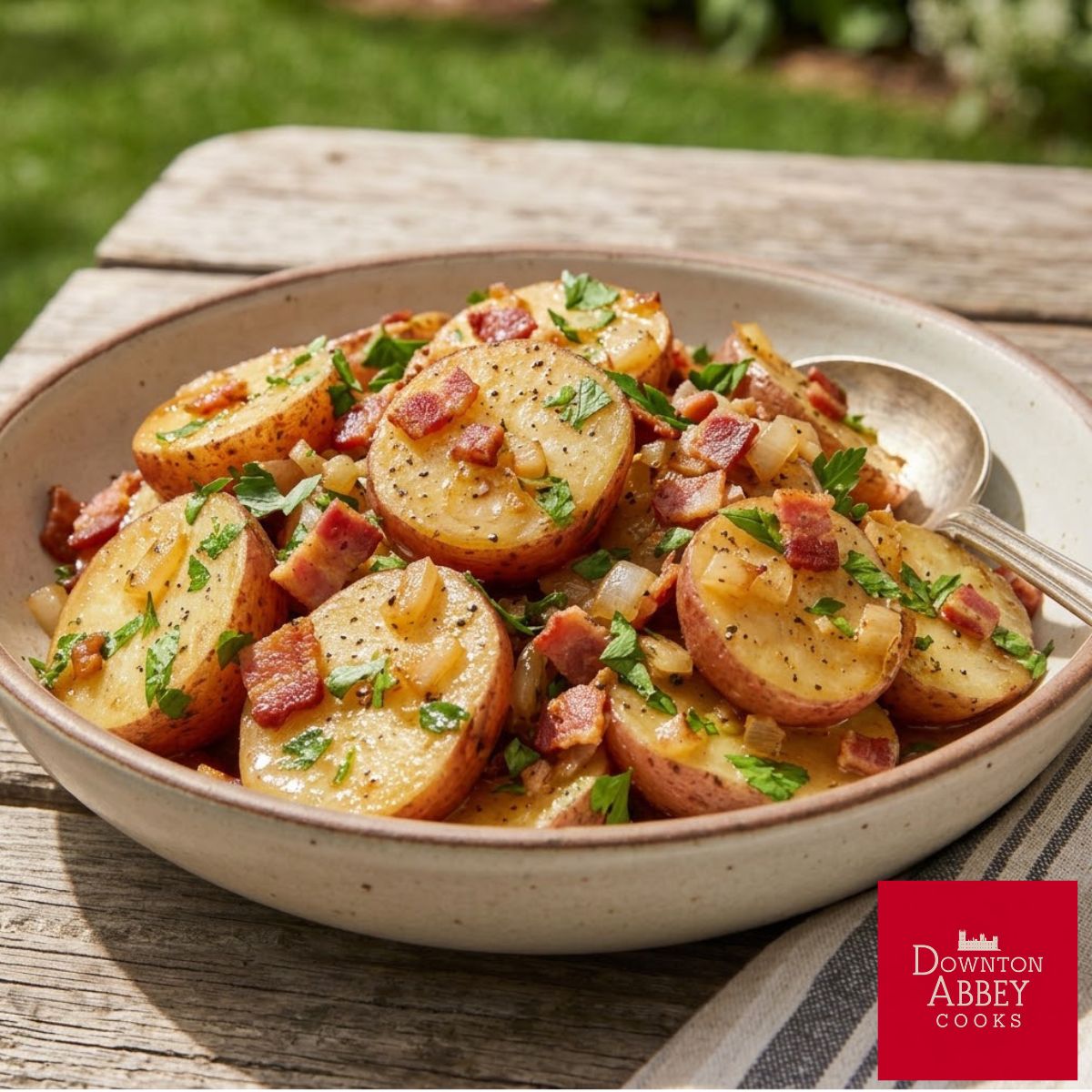
German Potato Salad Without Mayonnaise
Ingredients
- 2 lb 900 g waxy potatoes, such as red or Yukon Gold, scrubbed but not peeled
- 6 slices thick cut bacon chopped
- 1 medium medium onion finely chopped
- 1/4 cup 60 ml cider vinegar
- 1/2 cup 120 ml hot potato cooking water
- 1 tbsp sugar
- 1 tsp dry mustard
- 1 tsp salt plus more to taste
- Black pepper generously
- 3 tbsp chopped parsley

Instructions
- Boil the potatoes whole in salted water until a knife slides in with no resistance, about 20 to 25 minutes. Reserve half a cup of the cooking water before you drain them.
- Peel the potatoes while they are still hot. The skins come away with a paring knife and a tea towel. Slice them about a quarter inch thick into a wide bowl.
- Fry the bacon in a heavy pan until crisp. Lift it out and set it aside, leaving the fat behind.
- Cook the onion in the bacon fat over medium heat until soft and just golden, about five minutes.
- Add the vinegar, the reserved potato water, the sugar, the dry mustard, the salt and plenty of pepper. Bring it to a simmer and let it bubble for one minute.
- Pour the hot dressing over the warm potatoes. Add the bacon and parsley and fold it through gently. Warm potatoes drink the dressing. Cold ones do not, which is why timing matters more than technique here.
- Let it sit at least 30 minutes before serving. Taste again at the end. It will want more salt and more pepper than you expect.
Notes
Sharper: swap a tablespoon of the vinegar for pickle brine.
Make ahead: holds two days in the fridge. Bring it back to room temperature and add fresh parsley before serving.
Serve it with cold ham, rye bread, sharp mustard and a lager. That is the Elm Park table, more or less.