
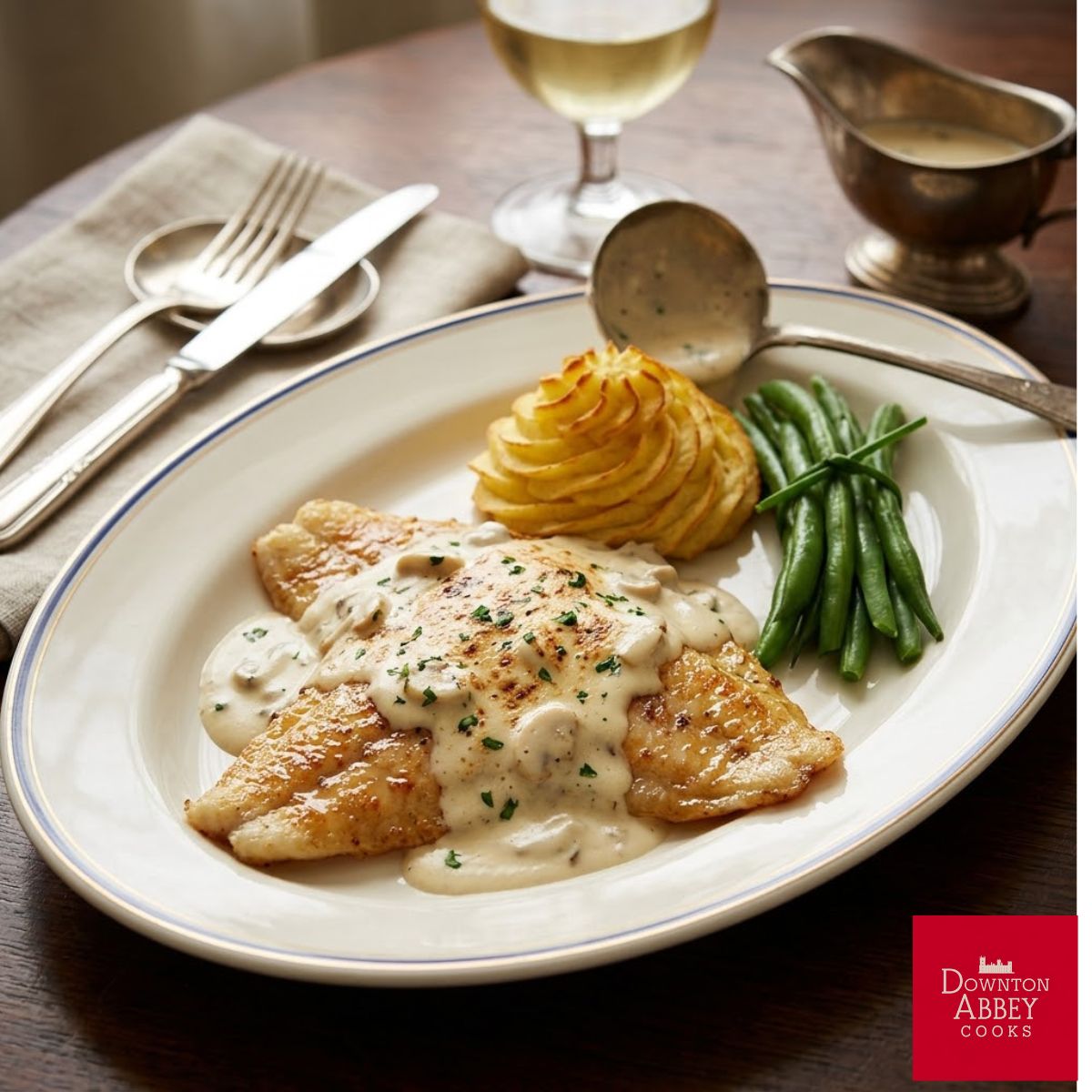
 Lobster got the headlines. Sole got the respect. Here is the fish dish that told a Gilded Age guest they truly mattered, plus how to make it at home.
If Lobster Newburg was the showpiece of the Gilded Age table, sole was the complement. Rich diners could order lobster to be seen. Serving delicate fillets of sole, poached in wine and cloaked in a creamy sauce, said something quieter and more expensive: that the host had a French-trained kitchen and the patience to use it. Stay with me, and you will understand why sole sat at the top of the menu, and you will be able to cook it yourself.
Why sole mattered so much
We think of lobster as the luxury of the era, and it was. But among people who knew food, sole was the true mark of a fine kitchen. It is a mild, delicate fish that punishes carelessness. Cook it a minute too long and it falls apart. Sauce it badly and there is nowhere to hide. A perfect plate of sole told a guest that real skill was at work behind the door.
That is why the great restaurants leaned on it. At Delmonico’s in New York, the birthplace of American fine dining, sole appeared again and again on the menus, always in the French style.
The man behind the method

The kitchen was run for most of the years between 1862 and 1896 by Charles Ranhofer, a French chef of the old school. He trained from the age of 12 and brought the full weight of classical French technique to New York.
In 1894 he published The Epicurean, an enormous cookbook of more than 3,500 recipes, meant to record everything Delmonico’s did. It includes dozens of ways with sole alone. The names changed, à la Normande, à la Marguery, and many more, but the heart of the house style stayed constant: poach the fillets gently in white wine, build a sauce from that poaching liquid, and enrich it with cream, egg yolk, and mushrooms.
That is the recipe worth having, because it is the technique, not any single garnish, that makes it Delmonico’s.
Sole versus lobster: two kinds of showing off
The Gilded Age had two ways to impress with seafood, and they said different things.
Lobster Newburg was loud. It was rich, dramatic, and named after a feud, which only added to its fame. It announced wealth.
Sole was soft-spoken. It announced taste. Anyone with money could buy lobster. Serving flawless sole meant you had the kitchen and the judgment to handle a fish that does not forgive. To a knowing guest, the quiet dish was the greater honour.
Understanding that difference is the useful part. When you cook sole this way, you are not making the flashiest dish on the table. You are making the one that says you know what you are doing.
You can make it at home
The good news is that the method scales down beautifully. You do not need Dover sole, which is European and hard to find here. Any thin, mild white fillet works: grey sole, lemon sole, flounder, or fluke, exactly as many American kitchens used even then. You poach the folded fillets in white wine, make a quick sauce from the liquid with butter, flour, cream, an egg yolk, and mushrooms, then glaze it under the broiler.
Fillets of sole à la Delmonico: quick answers
What is Fillets of Sole à la Delmonico? A Gilded Age dish of sole fillets poached in white wine and finished with a rich cream sauce with mushrooms, in the French style served at Delmonico’s in New York.
Who created it? The dish comes from the kitchen of Delmonico’s under chef Charles Ranhofer, who recorded the restaurant’s sole preparations in his 1894 cookbook The Epicurean.
What kind of sole should I use? True Dover sole is European and hard to find in North America. Grey sole, lemon sole, flounder, or fluke all work well and suit the dish.
Why was sole a luxury in the Gilded Age? Sole is delicate and unforgiving to cook, so a perfect plate signaled a skilled French-trained kitchen. To knowing diners it was a greater mark of refinement than lobster.
A final thought
The Gilded Age is remembered for excess, but its best cooking was about control. Fillets of sole à la Delmonico is the proof. No drama, no spectacle, just a delicate fish handled perfectly and finished with a sauce that took real skill to make. That is a kind of luxury we have almost forgotten, and it is worth bringing back to your own table. Poach it gently, keep the sauce off the boil, and you are cooking the way New York’s finest kitchens do.
Fillets of Sole à la Delmonico
Ingredients
For the Fish
- 4 sole or flounder fillets about 5 oz (140g) each
- 1 cup 250ml dry white wine
- 1/2 cup 125ml fish stock or water
- 1 shallot finely chopped
- 2 tbsp butter for the dish
- Salt and white pepper
For the Sauce
- 3 tbsp butter
- 3 tbsp all-purpose flour
- The strained poaching liquid plus more stock if needed to make 1 1/2 cups
- 1/2 cup 125ml heavy cream
- 1 egg yolk
- 8 oz 225g white mushrooms, sliced
- Squeeze of lemon juice
- Salt white pepper, and a pinch of cayenne
- Chopped parsley to garnish

Instructions
Poach the fillets
- Heat the oven to 375°F (190°C). Butter a shallow baking dish and scatter the shallot over it. Season the fillets with salt and white pepper, fold each one in half, and lay them in the dish. Pour over the white wine and fish stock. Cover with buttered parchment and poach in the oven for about 10 minutes, just until the fish is opaque and firm. Do not overcook.
Save the liquid
- Carefully lift the fillets onto a plate and keep them warm. Strain the poaching liquid into a measuring cup. This is the flavor base of the whole dish, so do not throw it away.
Cook the mushrooms
- Melt 1 tbsp of the butter in a skillet and cook the sliced mushrooms with a squeeze of lemon until soft and their water has cooked off. Set aside.
Make the sauce
- In a saucepan, melt the remaining 2 tbsp butter and stir in the flour. Cook for a minute without coloring. Whisk in the strained poaching liquid a little at a time until smooth, then simmer until it thickens and coats a spoon. Stir in the mushrooms.
Enrich and finish
- Whisk the cream and egg yolk together in a bowl. Lower the heat right down, stir the cream mixture into the sauce, and warm it through without letting it boil. Season with salt, white pepper, and a pinch of cayenne.
Glaze and serve
- Pour the sauce over the warm fillets. For the true Delmonico's finish, slide the dish under a hot broiler for a minute until the top is glossy and lightly golden. Scatter with parsley and serve at once.