
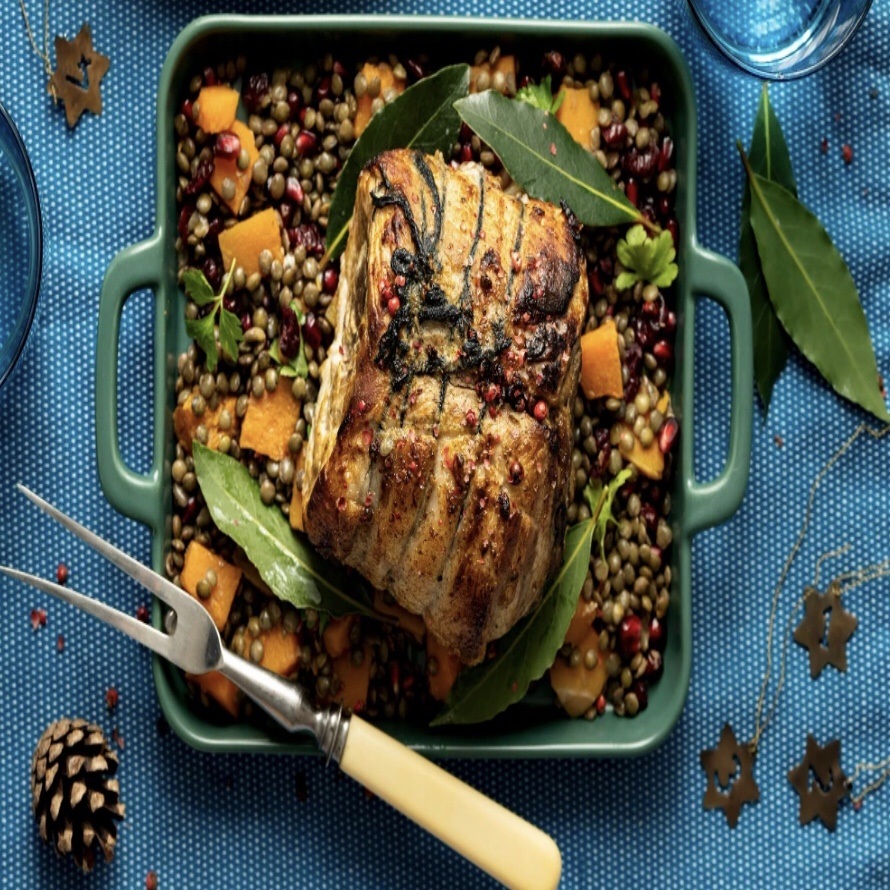
 There is a scene in every proper British household, repeated week after week since long before the Crawleys sat down at their own long mahogany table. The roast arrives. Someone lifts a knife. The room goes quiet. And then, if the carver knows what they are doing, the first slice falls away clean, the juices settle, and a hush of approval ripples round the table.
Carving is not a skill our grandmothers wrote down. They simply knew. But somewhere between the butler’s pantry and the modern microwave, that quiet confidence got lost. Today, most of us hack at the Sunday roast and hope for the best.
This guide is for anyone who wants to carve their Sunday roast the way it was meant to be done, calmly, precisely, and with a knife that feels good in the hand. Whether you are tackling a standing rib of beef, a leg of lamb, a Sunday roast pork, or a golden roast chicken, here is how to do it like Carson himself would approve.
Why Carving Was a Butler’s Job in the First Place?
In Downton’s day, carving at the head of the table was not simply tradition, it was a statement. A skilled butler could carve a leg of lamb into twenty thin, even slices that fanned out like a deck of cards. The Edwardian service à la russe, where food was brought in and served course by course, made carving a theatrical moment. Everyone watched.
The tools mattered enormously. Every great house owned a dedicated carving set, a long, narrow knife and a two-pronged fork, often in a presentation case, sometimes engraved with the family crest. These were not kitchen tools. They lived in the dining room sideboard, alongside the silver.
What made these knives special? A thin, flexible blade that glided rather than sawed. A handle balanced to reduce wrist fatigue over a long service. And the kind of craftsmanship that meant the same knife carved Christmas dinner for fifty Christmases.
It is a tradition worth reviving, and it starts with one truth: a good carving knife changes everything.
The Only Three Tools You Actually Need
Forget the twelve-piece knife block gathering dust on your counter. For a proper Sunday roast, you need three things:
- A sharp carving knife: ideally 9 to 11 inches long, with a narrow, slightly flexible blade. This is the star.
- A carving fork: sturdy, with long tines to hold the meat without tearing it.
- A carving board with a juice groove: to catch the precious jus that will later become your gravy.
The knife is the one tool worth spending real money on. A poorly made carving knife will bruise and shred the meat, releasing juices before they should be released. A well-made one slides through a sirloin as if the roast were butter at room temperature.
This is where French artisan cutlery has quietly become the choice of serious home cooks. Workshops still hand-forge blades from carbon and Damascus steel, with handles crafted from rare natural woods, from bog oak preserved in peat for 5,000 years. If you are in the market for a carving knife that will outlast you and be passed to your children, it is worth exploring what a handcrafted kitchen and table knife actually feels like in the hand. The difference from a supermarket blade is not subtle.
The Golden Rule No One Tells You: Rest the Roast
Before we carve a single slice, we need to talk about what you do the moment the roast comes out of the oven.
Do nothing.
That’s right. Set the roast on your board, tent it loosely with foil, and leave it alone for at least 15 minutes for a chicken, 20 for a leg of lamb, and 25 to 30 for a rib of beef. This is the rest, and it is non-negotiable.
During roasting, the muscle fibres contract and push their juices towards the centre of the meat. If you carve immediately, those juices flood the board and your beautiful roast turns grey and dry within minutes. Let the meat rest, and the juices redistribute evenly throughout. Every slice will be rosy, tender, and dripping with flavour.
Use this resting time to warm your plates, mix your horseradish cream, and pull the Yorkshire puddings from the oven.
Carving Beef: The King of the Sunday Roast
A classic standing rib roast or sirloin is the crown jewel of a British Sunday table. It is also, somewhat counterintuitively, one of the easiest cuts to carve beautifully, if you follow a few rules.
Step 1. Identify the grain: Look at the top of the roast. You will see the muscle fibres running in one direction. You must carve across the grain, perpendicular to those fibres. This shortens each fibre and makes every slice meltingly tender.
Step 2. Steady the roast with your carving fork: Plant the fork firmly into the meat, just away from where you will cut. Do not stab decoratively. Commit.
Step 3. Use the full length of the blade: A common mistake is to saw with short, panicked strokes. A proper carving knife cuts with long, smooth pulls, as if you were playing a slow note on a cello. One stroke per slice. Let the weight of the blade do the work.
Step 4. Aim for slices between 4 and 6 millimetres thick: thin enough to be elegant, thick enough to hold their juice. Fan them across a warm platter.
Carving a Leg of Lamb: The French Technique That Conquered Britain
A leg of lamb is more awkward than a beef joint because the bone runs through it. But there is an elegant method, borrowed from French butchers and perfected in English country houses, that makes it almost effortless.
The butler’s method:
- Place the leg on the board with the rounded, meatier side facing up and the shank bone to your right (or left, if you are left-handed).
- Insert your carving fork into the meatier side to hold it firmly.
- Carve the first slice by cutting down to the bone at a 45-degree angle, starting about a third of the way along from the shank end.
- Continue making parallel slices, each about 5 millimetres thick, working your way along the bone.
- When you have carved the top side, run your knife along the bone to release all the slices at once.
- Turn the joint over and repeat on the underside.
The result: long, elegant slices with a beautiful pink centre and a caramelised edge. Pair it with a proper coronation roast leg of lamb recipe if you want to try it Ken Hom style.
Carving Pork: The Secret Is in the Crackling
Roast pork is a creature unto itself. The challenge is the crackling, that shattering, glassy layer of skin that can defeat even the sharpest knife.
The trick: carve the crackling off first, in one piece, before you slice the meat. Slide your knife between the fat layer and the flesh, working slowly, keeping the blade flat against the meat. Lift the crackling off and set it aside on a warm plate.
Now carve the meat in clean, even slices, across the grain as always. Break the crackling into shards with your hands and scatter them over the platter.
Carving a Roast Chicken: Smaller, But No Less an Art
A whole roast chicken looks simple until you try to carve it gracefully in front of six hungry family members. Here is the order that works every time:
- Remove both legs first. Pull each leg away from the body and slice through the skin connecting them. Pop the joint with the tip of your knife and detach.
- Separate thigh from drumstick at the joint.
- Remove both breasts whole. Run your knife down along the breastbone, staying as close to the bone as possible. The whole breast should come away in one piece.
- Slice each breast across the grain into three or four thick slices.
- Arrange on a warm platter, legs and thighs framing the sliced breast.
This is the method used in every Edwardian household and every French bistro. It takes a minute. It looks spectacular.
The Small Rituals That Make It Downton
A few final touches that will elevate your Sunday roast from meal to occasion:
Warm the carving board. A cold board sucks heat from the meat immediately. Run it under hot water and dry it thoroughly before the roast arrives.
Pour the collected juices over the sliced meat. That jus in the groove is not waste, it is the concentrated soul of the roast.
Carve at the table. In proper Edwardian fashion, the carving happens in front of the guests. It is a small piece of theatre, and it matters.
Keep your knife sharp. A dull carving knife is a dangerous one. Ten seconds on a honing rod before each service keeps the edge true.
The One Investment That Changes Everything
If there is one lesson from a century of butlers and cooks, it is this: the knife matters more than the recipe.
You can follow every step in this guide with a cheap blade and your Sunday roast will still be acceptable. Do the same with a well-balanced, hand-forged carving knife that feels alive in your grip, and something quite different happens. The slicing becomes easy. The meat looks better on the platter. You carve more confidently, more slowly, more gracefully. And suddenly, you are not just cooking dinner. You are keeping a tradition alive.
A good knife, properly cared for, will carve fifty Christmas dinners. The cheap one will bend on the third one.
Choose well. Carve often. And let the room go quiet when the roast arrives.