
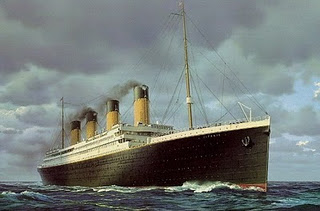
Tomorrow marks 114 years since the Titanic struck an iceberg. In 2023, five people paid $250,000 each to visit the wreck. They never came home. Why can’t we leave this ship alone?
The $250,000 Meal That Never Happened
In June 2023, five people climbed into a submersible the size of a minivan, piloted by a video game controller, and descended toward the wreck of the Titanic. They had each paid $250,000 for the experience. The eight-day expedition included a private room on the support vessel, dive training, expedition gear, and all meals on board.
They never reached the bottom. An hour and forty-five minutes into the descent, the Titan imploded. All five died instantly — the CEO who built it, a British billionaire, a French deep-sea explorer, and a Pakistani businessman and his nineteen-year-old son.
Here’s the detail that stays with me as a food historian: for $250,000 per person, OceanGate’s passengers were promised meals on the support ship. Not on the submersible itself — there’s no dining at 12,500 feet. The most expensive ticket in modern Titanic history bought you a trip to stare at a wreck through a porthole, and dinner was back on the boat afterward.
In 1912, a first-class ticket on the Titanic cost roughly $4,350 — about $130,000 in today’s money. For that, you got ten courses prepared by 62 kitchen staff producing Escoffier-influenced cuisine. Consommé Olga. Filet Mignons Lili. Punch Romaine between courses so you could keep eating. Waldorf Pudding. Chocolate éclairs with French vanilla ice cream.
A third-class ticket cost about $35 — around $1,100 today. For that, you got roast beef, plum pudding, and fresh bread. For many of those passengers, it was the finest meal of their lives.
OceanGate charged nearly twice the price of a first-class Titanic ticket, adjusted for inflation. And nobody ate at the wreck site. The food — the thing that actually connected people to the Titanic experience in 1912 — wasn’t part of the package.
We’ve Always Been Obsessed
The Titanic has never really left us. The ship sank in 1912, and the world has been telling the story ever since — in books, in films, in museums, in cookbooks, and, for the past fifteen years, on this blog.
I started Downton Abbey Cooks because the show opens with the sinking of the Titanic. That wasn’t an accident on Julian Fellowes’ part. He chose it because the disaster shattered the certainty of the Edwardian class system — the heirs died, the fortunes were at risk, and the assumption that wealth and position would protect you was proven catastrophically wrong. It’s the inciting event of the entire series.
But the Titanic’s hold on us goes deeper than Downton. James Cameron’s 1997 film grossed over two billion dollars. You can watch Titanic on Prime anytime. Museums in Pigeon Forge, Branson, and Orlando draw millions of visitors a year — and in 2026, they’re still expanding their exhibits, adding new artifacts and beefing up their dining galleries. Cruise lines run Titanic-themed memorial crossings. And every April 14th, people around the world cook from the ship’s menus.
I’m one of them. For the 100th anniversary in 2012, I cooked every dish from every class of service — first, second, and steerage. It was a marathon. I’ve been doing some version of it every year since.
So when Stockton Rush founded OceanGate and started charging a quarter of a million dollars to visit the wreck, he wasn’t inventing our obsession. He was monetizing it. And that’s worth thinking about — not to score points against a man who’s already dead, but because the line between honouring the Titanic and consuming it is thinner than we’d like to admit.
Hubris, Then and Now
The parallels between 1912 and 2023 are uncomfortable.
The Titanic was marketed as virtually unsinkable. Its builders cut corners on lifeboats — there were enough for about a half of the people on board — because the ship itself was supposed to be the safety system. The Board of Trade regulations were outdated. Warnings were ignored. The ship sailed at near-full speed into an ice field because slowing down wasn’t what first-class passengers were paying for.
Stockton Rush built the Titan’s hull from carbon fibre — a material that multiple deep-sea engineers warned him was unsuitable for repeated high-pressure dives. He didn’t certify the vessel with any maritime safety organization. Boeing and the University of Washington both ended their partnerships with OceanGate over safety concerns. A marine technology society wrote to Rush directly, warning him that his approach was dangerous. He dismissed the concerns.
In 1912, the people in charge believed that technology and ambition could override the laws of nature. In 2023, the same thing.
And in both cases, it was the passengers who paid the price.
The Downton Connection
If you read this blog, you understand the upstairs/downstairs lens I bring to everything. The Titanic was Downton Abbey on water — first class above, steerage below, a massive kitchen staff in between making it all work.
The OceanGate disaster is, in a strange way, the opposite of Downton’s story. Downton begins with the Titanic because it shows what happens when the class system is disrupted from the outside — by an iceberg, by fate, by forces the people at the top couldn’t control. The tragedy was that innocent people died because the system wasn’t designed to protect everyone equally. Third-class passengers had the lowest survival rate not because they were less important, but because the lifeboats weren’t meant for them.
OceanGate is different. There was no class system on the Titan. Everyone paid the same $250,000. Everyone was in the same minivan-sized vessel. The tragedy wasn’t that the system failed some passengers and not others — it’s that the system was rotten from the start, and everyone involved chose to trust it anyway.
Both stories are about hubris. But the 1912 version at least produced something beautiful along the way — extraordinary food, extraordinary music, extraordinary craftsmanship. The 2023 version produced nothing. No meal. No experience at the wreck. Just a catastrophic implosion and a four-day search that cost millions.
How to Actually Honour the Titanic
I don’t think cooking the Titanic’s food and visiting its wreck in a submersible are the same kind of remembering. One connects you to the people who were there. The other turns their tragedy into a spectacle.
When you make the Consommé Olga or bake the cabin biscuits from steerage, you’re doing something the passengers themselves did. You’re standing in a kitchen, following a recipe, feeding the people around you. That’s not tourism. That’s participation.
Museums do this well when they focus on the personal — the boarding passes, the letters home, the menus tucked into coat pockets. The Titanic Museum in Pigeon Forge gives every visitor a boarding pass with the name of a real passenger. At the end of the tour, you find out if your person survived. That’s honouring.
Charging $250,000 to peer at a rusting hull through a porthole? That’s something else.
Cook Something Tuesday
Tomorrow is April 14th — 114 years since the iceberg struck at 11:40 PM. If you want to mark it, don’t spend a quarter of a million dollars. Spend an afternoon in your kitchen.
Make the Punch Romaine — it takes five minutes, and it’s essentially a champagne slush. Make the Consommé Olga for the full first-class experience. Or make the cabin biscuits from steerage — fifteen minutes, four ingredients, the recipe that 700 emigrants would have recognized.
This week on the blog, I’ve posted a roundup of five Titanic dishes across all three classes and a deep dive into what steerage passengers actually ate on their last day. If you want the complete first-class ten-course menu with every recipe linked, that’s there too.
The best way to remember the Titanic isn’t to visit it. It’s to cook what the people on board ate, sit down at a table with the people you love, and remember that on the evening of April 14, 1912, more than two thousand people did exactly the same thing — not knowing it was the last time.
Great food has a history. This one deserves to be remembered.