
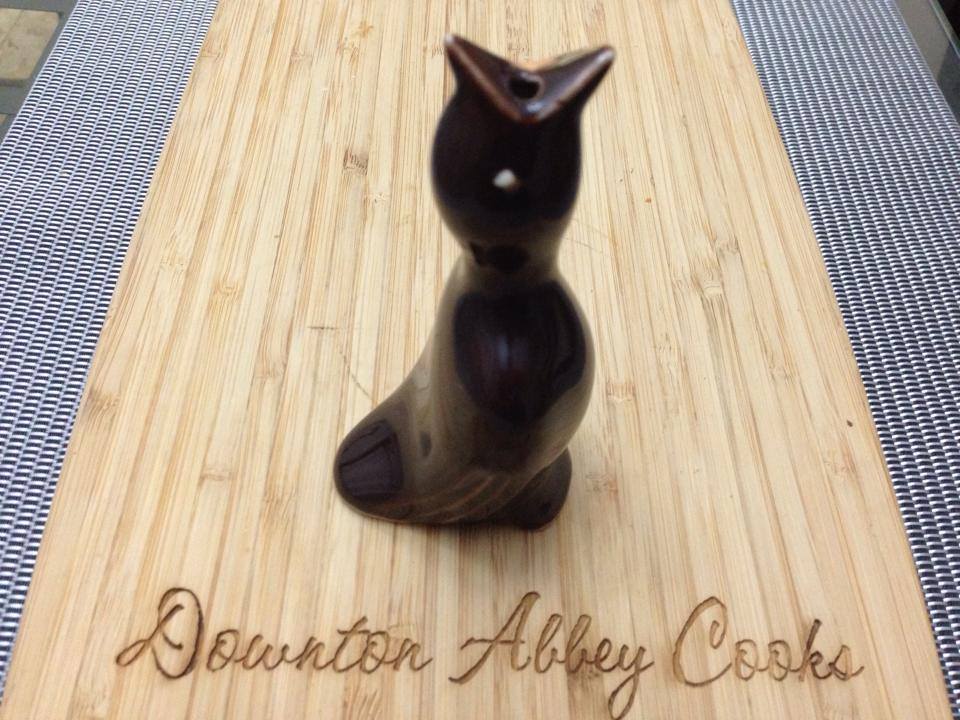
 Every year, my Aunt — affectionately known around here as Lady M, who some of you will remember from the Downton Abbey VPT Launch Weekend — has given me random kitchen gadgets for my birthday. One year, it was this pie bird. She had been keeping this little fellow safe for years and decided it was finally time to pass him along. He’s mine now and even more precious now that Lady M has passed. I named him Thomas, since he’s always getting hot under the collar.
Which seemed like a good occasion to dig into where these things came from.
What a Pie Bird Actually Does
A pie bird is a hollow ceramic tube — usually bird-shaped, though not always — that stands upright in the centre of a double-crust pie while it bakes. Steam from the filling escapes through the bird’s open beak instead of building pressure under the crust. The juices stay inside the pie where they belong, and the top crust holds its shape rather than sagging in the middle.
One small tool. Two problems solved.
From Plain Funnel to Decorative Bird
Pie birds originated in Britain during the late nineteenth century. Before modern ovens with thermostats, regulating heat was an imprecise business. Bakers often found their double-crust pies collapsing or boiling over, and the pie funnel emerged as a practical solution.
The British still call them pie funnels, and the earliest versions looked exactly like that: plain ceramic tubes. No charm. Just function. From the last years of the Victorian era, English cooks used these devices to vent steam from a bubbling pie and keep the contents from oozing out onto the oven floor.
The decorative shapes came later — and they came from Staffordshire, the heart of English ceramics.
Grace Seccombe, born in Staffordshire in 1880, registered a bird-shaped pie vent design in 1933. Because she was living in Australia at the time, the distinction of creating the first English pie bird generally goes to Clarice Cliff, also from Staffordshire, whose design was registered by A. J. Wilkinson Ltd. on January 18, 1936.
Cliff’s design was a nod to the nursery rhyme “Sing a Song of Sixpence.” Her advertising showed two blackbirds pecking out of a pie with the funnel in the middle. Many thousands were made and hand-painted at the factory, shipped around the world. The licence was constantly renewed because they sold so well.
Her stylized blackbird is widely recognized as one of the first commercially successful pie birds in Britain. Also during the 1930s and 1940s, Thomas M. Nutbrown Ltd. in Blackpool produced simpler white and yellow ceramic vents stamped with the Nutbrown name. Practical rather than pretty — and now collectible in their own right.
Pie funnels were in regular use through the early 1940s, then quietly disappeared into the backs of kitchen drawers. Post-war prosperity brought newer gadgets, and the pie bird lost ground. Collectors rediscovered them decades later.
They’re Not Always Birds
Despite the name, pie vents come in the shape of owls, elephants, quail, ducks, cows, chickens, and people. Some are quite decorative. And because they’re small, a collection doesn’t need much shelf space.
How to Use One
Place the pie bird in the centre of your pie plate. Lay the bottom crust in the dish, centre the bird on top, and spoon the filling around it. When you add the top crust, cut a small hole in the centre so the beak pokes through. Bake as normal.
The bird does its job without any fuss.
Worth Keeping an Eye Out For
If you come across one at an antique market, take a closer look. Vintage pieces — especially anything with a registered design number from the 1930s — are worth picking up. And if someone hands you one as a birthday gift, that’s a person who pays attention.
Do you have a pie bird? Tell me about it in the comments.