 Light spoilers for The Gilded Age, Season 4, Episode 3, “Ain’t That Good News.”
|
The short answer Jack Trotter is fictional, but his mixing machine has a real twin. On November 17, 1885, Rufus M. Eastman of Boston was granted U.S. Patent 330,829 for a “Mixer for Creams, Eggs, and Liquors.” It is generally thought to be the first mixer with an electric motor. Like Jack’s machine, it could run on more than one power source. |
This week marks 141 years since a Boston inventor patented a machine to beat eggs so cooks didn’t have to. On Sunday’s episode of The Gilded Age, Jack Trotter pitched something much the same.
Downton Abbey fans have met this machine before, too. Mrs. Patmore didn’t care for it either. More on that below.
The writers don’t name the real inventor. But the match is close enough that it’s worth a look. Here is what the 1885 mixer was, how it worked, and why any cook in 1886 would have wanted one. Then bake the cake that shows you why: angel food, the great American cake of the Beating Era.
What did Jack Trotter invent in The Gilded Age?
The episode opens with Jack explaining his newest idea: a mixing machine. He says it is built to work with any motor available at the time. “Water, spring, weight. But of course, electric is the most desirable.”
Jack made his money last season with a clock invention. Now he has moved into the kitchen. That makes sense for him. He spent years as a footman in the van Rhijn house, so he saw kitchen work up close.
He is also settling into his new place in society. He shows off his new artichoke-eating skills at lunch with Larry Russell. If you missed how that works, here is our guide to eating an artichoke the Gilded Age way.
Was there a real electric mixer in 1885?
Yes. Rufus M. Eastman of Boston filed his patent on March 6, 1885. It was granted on November 17, 1885, as U.S. Patent 330,829, titled “Mixer for Creams, Eggs, and Liquors.” Eastman assigned half of it to a Boston partner, Charles H. Wilder.
Historians of kitchen tools generally treat it as the first mixer with an electric motor. And here is the detail that ties it to Jack: patent accounts say it could run on mechanical, water, or electric power. Jack’s pitch lists the same choices.
Note the word “Liquors” in the title. Eastman meant his mixer for drinks and batters. So this was a gadget built for exactly the kind of evening Oscar and Enid were hosting later in the same episode.
How did the 1885 mixer work?
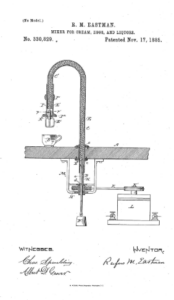
Forget the stand mixer on your counter. Eastman’s machine was a rig clamped to a table.
It looks clumsy to us. To a cook in 1885, it promised something huge: no more half hour of beating.
Why would a cook in 1886 want one?
Because in many cakes, the beating was the rising. Angel food cake is the clearest example. It has no butter, no egg yolks, and no baking powder. All its lift comes from a dozen egg whites beaten full of air. Less air means a flat, rubbery cake.
Mary J. Lincoln knew this well. She was the first principal of the Boston Cooking School, in Eastman’s own city. Her Boston Cook Book first came out in 1884, and it warns that a good sponge cake “requires strength in beating and judgment in baking.” That same book also included a recipe for angel food cake.
She wasn’t exaggerating. A later edition of her book includes Miss Ward’s Sponge Cake: 10 eggs and a pound of sugar, beaten for half an hour without stopping.
Cooks did have help. Rotary egg beaters had been around since the 1850s. The Dover beater, patented in 1870, became so common that “Dover” turned into a general word for egg beater. But it was still your arm turning the crank.
How did the egg beater make angel food cake famous?
Angel food cake and the egg beater rose together. Food historians tie the cake’s boom to the rotary beaters of the 1870s, which finally made whipping a dozen whites a job a home cook would take on.
By 1880, the New York Times was printing an angel food recipe. By 1883, it had reached the White House. First Lady Lucy Webb Hayes named it her favorite dessert. Mrs. Lincoln’s book followed in 1884.
That makes angel food the very cake Jack’s customers would have been baking. Agnes van Rhijn is planning a dinner for President Cleveland this season. A cake that pleased a First Lady three years earlier would not be out of place on her table.
Did anyone in 1886 actually own an electric mixer?
Almost no one. In 1886, very few New York homes had electric power. Thomas Edison’s Pearl Street power station had only opened in 1882.
The electric mixer took decades to catch on. The Hobart company built an electric stand mixer for bakeries in 1908. Electric mixers were rare in home kitchens before the 1920s.
When did the electric mixer finally reach Downton Abbey?
Downton fans have seen what happened when one finally arrived. In the Series 4 opener, set in 1922, a new electric mixer lands in Mrs. Patmore’s kitchen. Daisy and Ivy can’t wait to try it. Mrs. Patmore gives it the evil eye for most of the episode.
Her problem wasn’t only the machine. She worried that labor-saving gadgets like this one could replace her. In a house already cutting staff, that was a fair worry.
Do the math. Mrs. Patmore meets her mixer 37 years after Eastman’s patent and 36 years after Jack’s pitch. So Jack is selling to a world that won’t be ready for decades, and even then the cook won’t be thrilled. His timing is perfect for television and not so good for business.
We marked that Downton moment back in 2014 with a Chilled Tomato and Dill Mousse, a dish that gets its airy texture from whipped cream or egg whites. You can find it in Downton Abbey S4 Life Lesson: Electric Mixers Make Better Mousse.
What this means for your kitchen
You get to bake the cake an 1886 New York cook was proud of, without the sore arm. Your mixer does in minutes what took her a long, tiring stretch with a hand crank.
Our Never Fail Angel Food Cake is tall, tender, and light as a cloud. Serve it with fresh berries and whipped cream, or with a cup of tea. For every recipe we have tied to the show, visit our Gilded Age hub.
Then and now1886, by hand: half an hour or more of beating, with a whisk or a hand-cranked Dover beater. Today, with a stand or hand mixer: a few minutes to whip the whites to soft, glossy peaks. |
|
Make it: Never Fail Angel Food Cake Our tested recipe uses a dozen egg whites, cake flour sifted three times, and a 325°F oven. Everything Mrs. Lincoln’s readers did by hand, your mixer now does for you. |
Frequently asked questions
Was Jack Trotter a real inventor?
No. Jack Trotter is a fictional character in HBO’s The Gilded Age. His mixing machine closely matches a real invention, though: Rufus M. Eastman’s 1885 patent mixer.
What was the first electric mixer?
The first mixer with an electric motor is generally credited to Rufus M. Eastman of Boston. His “Mixer for Creams, Eggs, and Liquors” was patented on November 17, 1885.
When did home cooks start using electric mixers?
Not for a long time. Hobart built an electric stand mixer for bakeries in 1908, and electric mixers were rare in homes before the 1920s.
Which Downton Abbey episode has the electric mixer?
Series 4, Episode 1, set in 1922. A new electric mixer arrives in the kitchen. Daisy and Ivy are excited about it. Mrs. Patmore is not.
When was angel food cake invented?
Angel food cake is an American cake that became popular in the 1870s and 1880s, helped along by the rotary egg beater. The New York Times printed a recipe in 1880, and First Lady Lucy Webb Hayes called it her favorite dessert in 1883.
Why does angel food cake need so much beating?
It has no butter, no yolks, and no baking powder. The air whipped into the egg whites is the only thing that makes it rise.
Can I make angel food cake without a mixer?
Yes, with a balloon whisk or a rotary egg beater. It just takes much longer and a strong arm, which is the whole point of Jack’s invention.
Final thought
Great food has a history, and so do the tools we use to make it. Jack Trotter’s machine is fiction, but the problem it solved was real. Every cook in 1886 who beat eggs for half an hour would have bought one. Bake an angel food cake this week, and give your mixer a little thank-you while it works.