
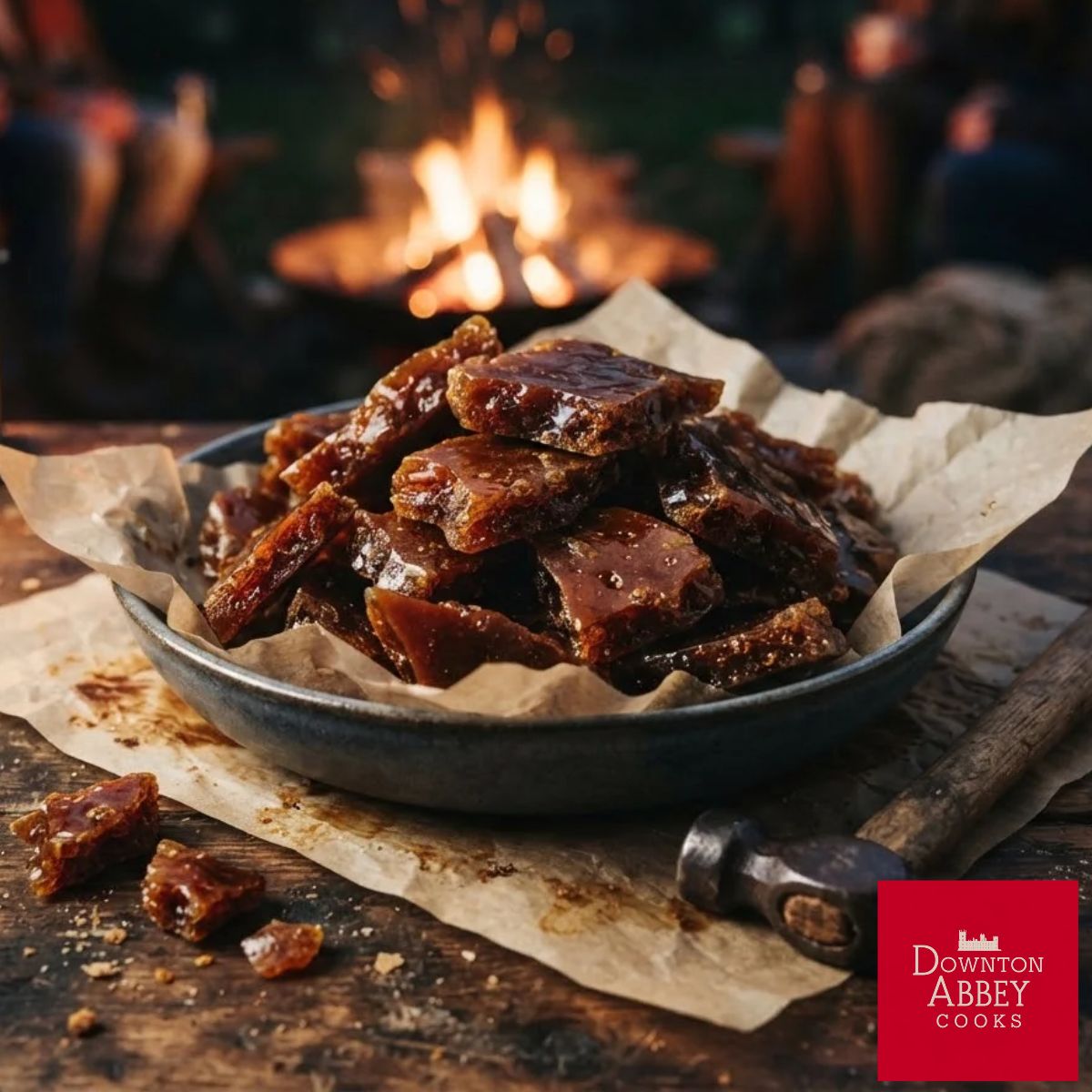
Every year on November 5, Britain lights its bonfires for Guy Fawkes Night. And across the north of England, there is a slab of dark, glossy toffee waiting to be cracked.
This is bonfire toffee. It takes five ingredients and about 15 minutes on the stove. It sets in an hour and keeps for weeks in a tin. If you like molasses cookies or old-fashioned butterscotch, you are going to love it, and so is anyone standing near your fire pit.
Here is how to make it, what the British ingredients mean at an American grocery store, and the story behind it, which starts with a plot in 1605. The recipe card is at the bottom of the post.
What Is Bonfire Toffee?
Bonfire toffee is a hard, brittle British candy made from black treacle, brown sugar, golden syrup and butter. It is boiled to a high temperature, poured into a pan, and broken into shards once it sets. It is traditionally eaten on Bonfire Night (Guy Fawkes Night, November 5) and at Halloween, especially in the north of England.
It also goes by treacle toffee, plot toffee and Tom Trot. In Scotland it is called claggum, and in Wales it is loshin du.
What Does Bonfire Toffee Taste Like?
Think of a cross between butterscotch hard candy and molasses brittle, without the nuts. The black treacle gives it a deep, slightly bitter edge that keeps it from tasting simply sweet.
It is not the toffee most Americans picture. A Heath bar is buttery “English toffee” made with plenty of butter and often almonds. Saltwater taffy is pulled until it turns soft and chewy. Bonfire toffee is neither. It is glassy, dark and crunchy, and it melts slowly once it is in your mouth.
Why Is It Called Bonfire Toffee?
The name comes from Bonfire Night, the British holiday that marks the failed Gunpowder Plot of 1605. When a plan to blow up Parliament and King James I was discovered, Londoners lit bonfires to celebrate. Britain has lit them every November 5 since, and the toffee became part of the night.
Exactly why toffee joined the bonfire is less clear. Food writers have never pinned it down. My best guess is the season: treacle is a warming, wintry flavor, and a slab of hard toffee travels well in a coat pocket on a cold night.
The other names tell their own stories. “Plot toffee” nods to the Gunpowder Plot. “Treacle toffee” simply names the main ingredient. “Tom Trot” was in use by the 1890s.
A Short History of Treacle Toffee
Treacle, the British word for molasses, arrived in British kitchens in the 1660s, when cooks began using it in gingerbread. Treacle toffee followed. At first, though, treacle was sold as a medicine and priced like one, so toffee stayed a treat rather than an everyday sweet.
The word “toffee” itself first appears in print in 1825, though people were surely boiling sugar long before anyone wrote the word down. Hard toffee took hold in the north of England, and from about 1830 to 1900, bonfire toffee was a Yorkshire favourite.
Most people made it at home. Even after factories began making candy in the 1840s, black treacle often cost more than sugar, so shop-bought treacle toffee was out of reach for many families. As late as the 1960s, older neighbours in many British towns still made bonfire toffee to hand out to children on November 5. They often poured it onto big sheets and broke it up with a small toffee hammer.
Would Downton’s Kitchen Have Made Bonfire Toffee?
Downton Abbey is set in Yorkshire, the county where bonfire toffee was most popular. By the time the series opens in 1912, the toffee had been a Yorkshire favorite for generations.
So it is easy to picture a slab cooling in Mrs. Patmore’s kitchen in early November, next to a pan of Yorkshire parkin, Bonfire Night’s other great Yorkshire treat. The series never shows it, but the county’s habits point that way.
Bonfire Toffee Ingredients, Translated for American Kitchens
You need just five ingredients. Two of them have British names, and both have easy American swaps.
| Recipe calls for | What it is | American swap |
|---|---|---|
| Black treacle | A thick, dark British syrup, similar to molasses but a little milder | Regular unsulphured molasses. Skip blackstrap, which is too bitter. |
| Golden syrup | A pale, buttery British cane syrup (Lyle’s is the best-known brand) | Light corn syrup. Or look for Lyle’s in the international aisle. |
| Light soft brown sugar | British name for soft, moist light brown sugar | Light brown sugar |
| Unsalted butter | Same on both sides of the Atlantic | No swap needed |
| Cream of tartar | A powder that keeps the sugar from turning grainy | Find it in the spice aisle |
Real black treacle gives the deepest flavour, so if you can find it, use it. Molasses makes a very good toffee too. It will just taste a little sharper.
Tips for Perfect Bonfire Toffee
Candy making is mostly about temperature. Get that right and everything else is easy.
- Use a candy thermometer. For toffee that snaps cleanly, cook it to 300°F, the hard crack stage. Pull it off the heat at 285°F and it sets firm but slightly chewy.
- No thermometer? Use cold water. Drop a little syrup into a glass of ice water. If it forms brittle threads that snap when you bend them, it is ready.
- Choose a deep, heavy pan. The mixture bubbles up as it boils, and a heavy base keeps it from scorching.
- Never taste it from the pan. Boiling sugar is far hotter than boiling water and sticks to skin. This is a recipe for grown-ups to make and children to eat.
- Score it while it is warm. After 15 to 20 minutes, mark lines with an oiled knife. Once it is cold, it breaks neatly along them. Or skip the knife and crack it into shards with a rolling pin.
- Make it on a dry day. Hard candy pulls moisture from the air. On a humid day it can turn sticky, so cook it a few degrees hotter and store it right away.
- Store it airtight. Keep it in a tin or jar with parchment paper between layers, at room temperature. It keeps for a few weeks.
How to Serve Bonfire Toffee
Put it out in paper bags or a bowl beside the fire, the way it has been handed around on November 5 for generations. For a full Bonfire Night spread, add Yorkshire parkin, three-ingredient English flapjacks, and a pot of hot Guy Fawkes punch or Mrs. Beeton’s drinking chocolate for the kids. My Guy Fawkes Day guide has the history and the whole menu.
Bonfire toffee works well beyond November 5, too. It belongs at an old-fashioned Halloween party, and wrapped in wax paper it makes a handsome addition to a holiday candy tray or a cookie tin for the neighbors.
Bonfire Toffee FAQ
What is the difference between bonfire toffee and treacle toffee?
There is none. They are two names for the same candy. “Bonfire toffee” refers to Bonfire Night, and “treacle toffee” refers to the black treacle that gives it its color and flavor.
Can I use molasses instead of black treacle?
Yes. Use regular unsulphured molasses. Avoid blackstrap molasses, which is much more bitter. The toffee will taste slightly sharper than one made with black treacle, but it will still be very good.
What temperature do you cook bonfire toffee to?
For hard, brittle toffee, cook it to 300°F (150°C), the hard crack stage. A slightly lower temperature, around 285°F, gives a firm toffee with a little chew.
Why is my bonfire toffee sticky?
It was most likely taken off the heat before it reached the hard crack stage, or it absorbed moisture from humid air. Cook it to 300°F next time and store it in an airtight container as soon as it is cold.
How long does bonfire toffee last?
Stored airtight at room temperature, with parchment between the layers, it keeps for a few weeks. Keep it away from the fridge, where moisture will make it sticky.
Is bonfire toffee gluten free?
The traditional ingredients (sugar, butter, treacle, golden syrup and cream of tartar) contain no gluten. If you are cooking for someone with celiac disease, check the labels on your syrups and butter.
A Taste of November 5
Bonfire toffee has outlasted the plot, the law that made November 5 a holiday, and most of the sweet shops that once sold it. It survived because it is cheap to make, easy to share, and very good. Make a batch, crack it into shards, and see how fast it disappears.
Great food has a history.
Traditional Bonfire Toffee
Ingredients
- 3 oz golden syrup (subsitute corn syrup)
- 3 oz black treacle (substitute molasses)
- 6 oz light soft brown sugar
- 3 oz unsalted butter
- 1/4 tsp cream of tartar

Instructions
- Line a small rectangular tin (6 x 8in) baking tray with non-stick baking paper.
- Place a deep saucepan on medium heat and add all the ingredients. Stir occasionally until the butter has melted and the sugar has dissolved. The mixture should be smooth.
- Turn up the heat and bring the mixture to a boil Using a candy thermometer, cook until the mixture reaches 300F. Careully pour the mixture into your pan. Let Cool.
- For even pieces: wait 15 - 20 minutes until the toffee is cool enough to handle, but elastic enough so that a finger pressed in the top leaves a slight indent. Use an oiled chef's knife to draw even lines. When it has cooled completely, you will be able to easily break the toffee along those lines. For more fun, let the toffee cool completely, then break into shards with a rolling pin.
- Store in an airtight container, using parchment paper to help keep layers separate.