
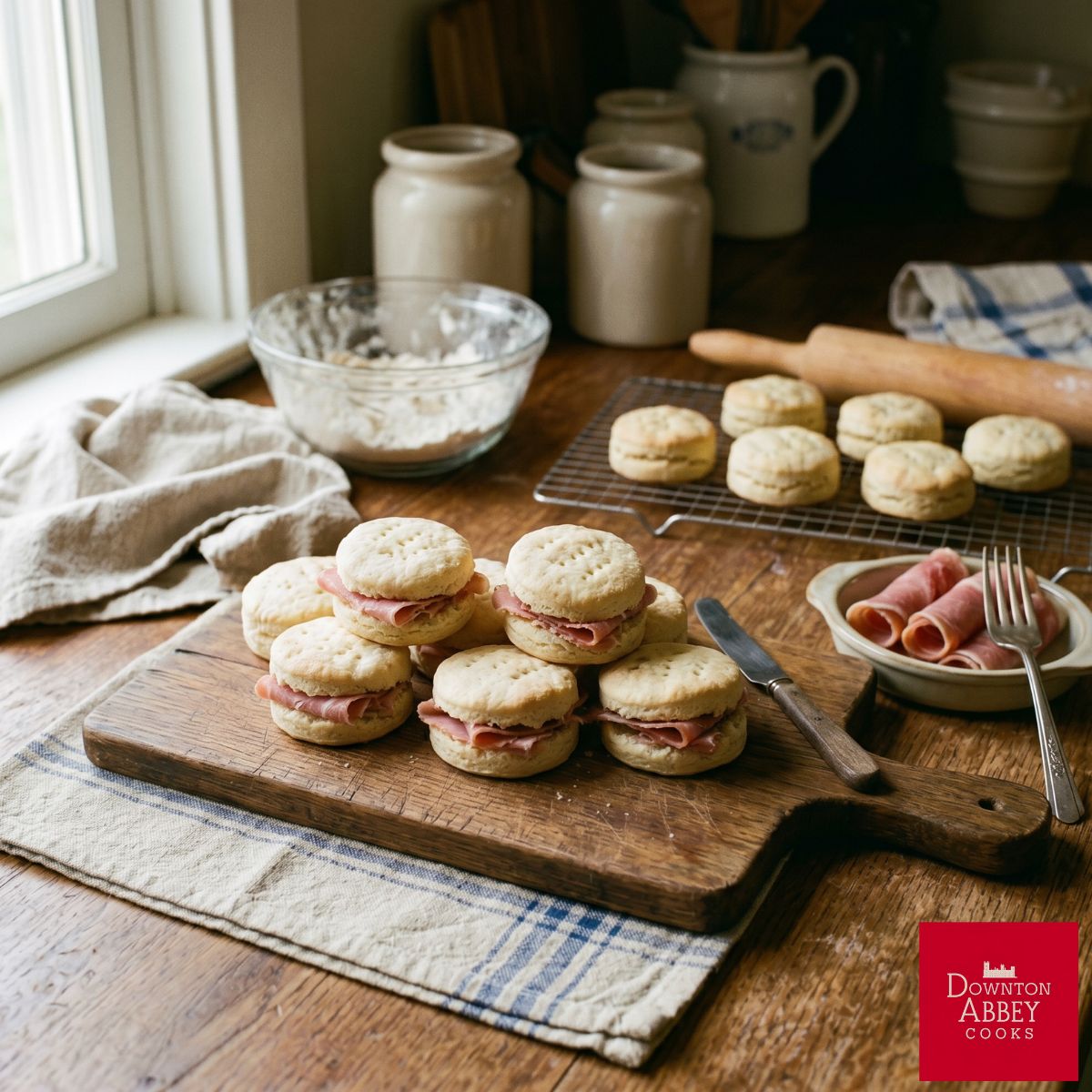
 Before baking powder, there was muscle. Beaten biscuits are what Southern cooks made when they needed a biscuit that lasted for days, and they are worth every minute of effort.
Beaten biscuits are not like any biscuit you have made before. They are dense, pale, and crisp. They do not rise. They do not flake. They keep for a week without going stale, which is exactly why Gilded Age households packed them into Derby hampers.
The technique is the recipe. You beat the dough with a mallet or rolling pin until it blisters, snaps, and sighs, a process that takes 20 to 30 minutes by hand. That mechanical work aerates the dough without any leavening. No baking powder. No yeast. Just force.
In wealthy households, servants did the beating. There is a saying that dates back to that era: “beat 200 times for family, 400 times for company”. The difference in texture is real.
Served split and tucked with thin-sliced country ham, they are one of the great small bites of Southern food. Most people have never had one.
What You Need to Know Before You Start
Lard is correct. Vegetable shortening works, but lard produces a better texture and more authentic flavour. Use leaf lard if you can find it.
Country ham is correct. This is salt-cured ham, not cooked ham. It is very salty, very thin-sliced, and deeply savoury. If you cannot find it, prosciutto is the closest substitute. Regular deli ham is not the same thing.
The dough will feel wrong at first. It starts stiff and rough. Keep beating. It will smooth out and begin to blister. When you fold the dough and it snaps back at you, you are getting close.
The modern shortcut works. A food processor fitted with a steel blade can do the beating in 4 to 5 minutes of continuous processing. Not traditional, but effective.
A Short History
 Beaten biscuits belong to the Upper South — Maryland, Virginia, and Kentucky — not the broader South. Maryland has the strongest claim. They appear in Mary Randolph’s The Virginia Housewife (1824), one of the earliest American cookbooks, which puts them firmly in the record before the Civil War.
The technique exists because chemical leavening did not. Baking powder became widely available around the 1850s. Before that, if you wanted any lightness in a biscuit without yeast, you beat the dough until the gluten did the work.
There is a story that rarely accompanies the recipe: in antebellum Southern households, this work was done by enslaved Black women. Thirty minutes of hard beating with an iron tool or the flat of an axe was not a charming kitchen ritual. It was labour. After emancipation, it became paid domestic work. The saying about 200 strokes for family and 400 for company was an instruction given to someone else.
Once baking powder was cheap and servants were gone, beaten biscuits nearly vanished. By the mid-20th century, most home cooks had stopped making them entirely. A few commercial bakeries in Maryland and Kentucky kept them alive. Gilded Age kitchens had a purpose-built solution: the beaten biscuit machine, a heavy iron device with a marble roller that mechanized the beating. Some antique shops in Kentucky still carry them. The food processor is the modern version.
Jennie Benedict, the Louisville caterer who created the Benedictine spread in the 1890s, almost certainly served beaten biscuits alongside it. That pairing is as Louisville as it gets.
Beaten Biscuits with Country Ham
Equipment
Ingredients
- 2 cups all-purpose flour (250g)
- 1/2 tsp fine salt
- 1 tsp sugar
- 4 tbsp lard, cold, cut into small pieces (55g), or cold vegetable shortening
- 1/2 cup ice water (120ml), plus more as needed

Instructions
Make the dough
- Whisk together flour, salt, and sugar in a large bowl. Cut in the cold lard with your fingertips or a pastry cutter until the mixture resembles coarse crumbs with a few pea-sized pieces remaining.
- Add ice water a tablespoon at a time, mixing with a fork after each addition. You want a stiff dough that just holds together — it should not be soft or sticky. You may need slightly more or less than 1/2 cup depending on humidity. Stop as soon as the dough comes together.
Beat the dough (traditional method)
- Turn the dough out onto a lightly floured board or clean counter. Using a mallet, rolling pin, or the flat side of a cleaver, beat the dough firmly and steadily. After each series of strokes, fold the dough in half, turn it 90 degrees, and beat again.
- Keep going for 20 to 30 minutes. The dough will become smoother and more elastic. After about 15 minutes, it should start to blister. When you fold it and it snaps, and the surface looks slightly glossy with small blisters, the dough is ready.
Beat the dough (food processor method)
- Combine flour, salt, sugar, and lard in the bowl of a food processor. Pulse 8 to 10 times until it resembles coarse crumbs. With the machine running, add ice water through the feed tube until the dough forms a ball. Continue processing for 4 to 5 minutes. The dough is ready when it is smooth and slightly glossy.
- Roll and cut
- Preheat your oven to 325°F (165°C).
- Roll the dough out on a lightly floured surface to about 1/4 inch (6mm) thickness. Cut with a small round cutter, approximately 1.5 to 2 inches (4 to 5cm) in diameter. Re-roll scraps once.
- Place on an ungreased baking sheet. Prick the top of each biscuit three times with a fork (the three-hole pattern is traditional and helps them dry evenly).
Bake
- Bake for 22 to 25 minutes until pale gold on top and lightly golden on the bottom. They should feel firm and dry, not soft. Do not overbrown — they should be pale.
- Cool completely on a wire rack before splitting.
Serve
- Split each biscuit through the middle with a sharp knife. Tuck in one or two thin slices of country ham or prosciutto. Serve at room temperature.
Storage
- Store in an airtight container at room temperature for up to one week. They actually improve after a day or two, which is why they were Derby hamper food.