
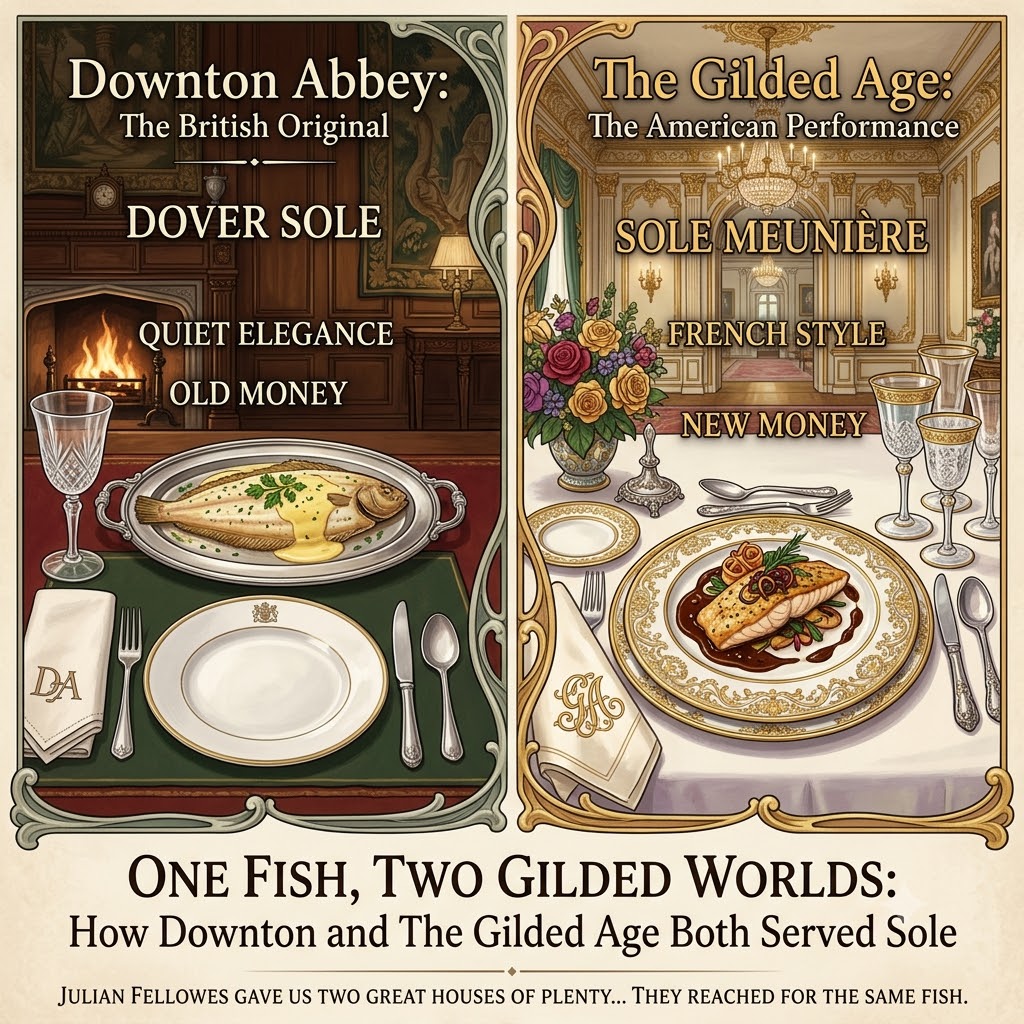
 Julian Fellowes gave us two great houses of plenty, one in Yorkshire and one in New York. They dressed differently and spoke differently, but they reached for the same fish. Here is the story of sole on both sides of the Atlantic, and how to serve it yourself.
Great food has a history, and sometimes a single dish tells two stories at once. Sole is one of those dishes. At Downton Abbey it meant European Dover sole, landed fresh and served with quiet British confidence. In the New York of The Gilded Age it meant French technique, a menu written in French, and a kitchen out to dazzle the Astors and the Russells. Same fish course, two very different rooms. The after here is a richer way to watch both shows, and a dish you can put on your own table this week.
Quick answer: Sole was the prized fish course in both the British and American worlds that Julian Fellowes portrays. In Britain, the Downton era ate true European Dover sole. In Gilded Age New York, elite restaurants like Delmonico’s served “filet de sole” in the French style, though the fish itself was often a local flatfish standing in for imported Dover sole. At home, lemon sole or flounder cooks up beautifully in either tradition.
What was the fish course, and why did it matter?
In both worlds, a formal dinner moved through many courses. The fish course came after the soup and before the meat, a lighter moment in a long meal. It was also a quiet test. A delicate fish, cooked well and sauced with skill, told your guests the kitchen knew its business and the host had money to spend. Sole, mild and firm, was the safe and elegant choice that passed that test every time.
Sole at Downton Abbey: the British original
In the Downton era, sole meant Dover sole, the European flatfish (Solea solea) prized for its clean flavour and firm texture. It was named for the English port of Dover, which landed the freshest sole for the London market. A great house would have served it as a matter of course, prepared by specialised staff and carried up by footmen.
The British approach leaned on restraint. Dover sole with hollandaise, all butter and lemon, let the fish speak for itself. It was elegance through simplicity, which suited the old aristocratic confidence of a family like the Crawleys. You did not need to shout when your name was already on the gate.
Sole in the Gilded Age: the American performance
Cross the Atlantic to the New York of the 1880s and the mood changes entirely. The Gilded Age fortunes were new, and new money announces itself. The elite dined in the French haute cuisine style set by Delmonico’s, the restaurant that defined high-society dining, under its celebrated chef, Charles Ranhofer. His 1894 cookbook, The Epicurean, is full of sole preparations, listed in French alongside terrapin, canvasback duck, and oysters.
Here is the twist worth knowing. True Dover sole is a European fish, and it is not found in American waters. So the sole on a Gilded Age menu was often a local flatfish, such as flounder, dressed in a French preparation and called “sole” for the prestige the name carried. As steamships and refrigeration improved throughout the late 1800s, genuine imported sole became available to the very wealthy, which only made it a sharper status symbol. The Russells of the show would have wanted the real thing, precisely because most could not get it.
The same fish, two kinds of wealth
Put the two tables side by side, and you see the difference between old money and new in a single dish. The British served real Dover sole and barely dressed it, trusting the fish and the family name. The Americans borrowed the name and the French technique, projecting sophistication even as they were still earning it. One world whispered. The other made an entrance. Both used the sole to do it.
That is the quiet pleasure of watching both Fellowes shows with a food historian’s eye. The recipes overlap, but the reasons behind them do not.
How to bring it home
You do not need a Yorkshire estate or a Fifth Avenue mansion. You need a good flatfish and a little butter. True Dover sole is expensive and hard to find in North America, so lemon sole, petrale sole, or flounder all work well. The technique matters more than the species.
For the British way, cook the floured fillets gently in butter and serve with a simple hollandaise. For the showier Gilded Age spirit, finish with a French flourish: sole meunière, where a fresh knob of butter is browned until nutty, brightened with lemon and parsley, and poured over the fish. Same fillet, two centuries, two continents.
The full method, with an easy immersion-blender hollandaise, is in my recipe post, Dover Sole: The Fish That Ruled the Edwardian Table.
Sole across both shows: quick facts
- Downton Abbey (Britain): true European Dover sole, served simply, often with hollandaise
- The Gilded Age (New York): “filet de sole” in the French style, often a local flatfish standing in for imported sole
- Defining American kitchen: Delmonico’s, under chef Charles Ranhofer, author of The Epicurean (1894)
- Why sole mattered: a delicate fish that signalled wealth and a skilled kitchen
- Best home substitutes: lemon sole, petrale sole, or flounder
Frequently asked questions
Did they eat Dover sole during the Gilded Age? Sole was a prized fish course in Gilded Age New York, served in the French style at restaurants like Delmonico’s. True European Dover sole had to be imported, so the fish was often a local flatfish prepared as “sole.” The wealthiest diners sought the genuine imported article as a status symbol.
What is the difference between how Downton and the Gilded Age served as sole? Downton-era Britain served real Dover sole, simply prepared, in the confident style of old money. Gilded Age New York leaned on elaborate French technique and the French name, performing sophistication in the style of new money.
What was Delmonico’s? Delmonico’s was the restaurant that defined high society dining in Gilded Age New York. Under chef Charles Ranhofer, it set the standard for French haute cuisine in America.
Can I cook sole at home today? Yes. Use lemon sole, petrale sole, or flounder, cooked in butter and finished with hollandaise or a browned lemon butter. It takes about 25 minutes.
A final thought
Two shows, two continents, one fish. Sole sat at the heart of both worlds Julian Fellowes loves to portray, and the small differences in how it was served say everything about the people at the table. Cook it this week, and you taste a little of each. Great food has a history, and this one spans an ocean.
If you make it, I would love to see it. Pass this to the friend who watches both shows with a snack in hand.
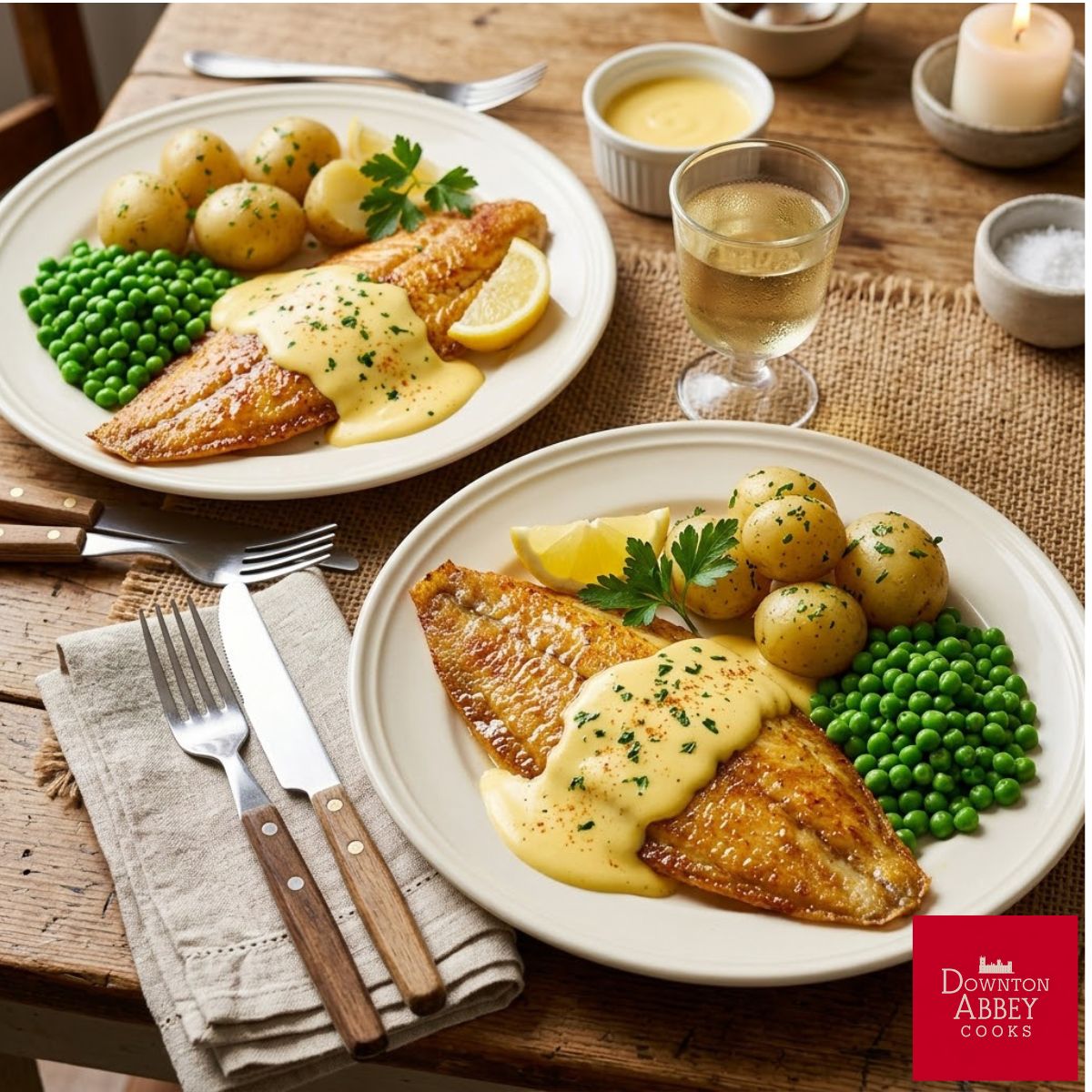
Dover Sole with Hollandaise
Ingredients
For the Fish
- 2 fresh Dover sole fillets or lemon sole, petrale sole, or flounder, about 6 oz (170 g) each
- 2 tbsp. flour
- 1 pinch Salt and white pepper
- 2 tbsp. butter
- 1 tbsp. oil
- Lemon wedges to serve
For the Quick Hollandaise
- 3 large egg yolks
- 1 tbsp. lemon juice
- 1/2 cup 115 g butter, melted and hot
- 1 Pinch of salt
- 1 Pinch of cayenne optional

Instructions
Make the hollandaise
- Melt the butter and keep it hot.
- Put the egg yolks and lemon juice in a tall, narrow cup or jar, just wide enough for your immersion blender head to reach the bottom.
- Pour the hot butter over the yolks and let it settle for a few seconds.
- Rest the immersion blender flat on the bottom of the cup and turn it on. Hold it still until the sauce starts to thicken around the head, then slowly lift it up through the mixture until everything is smooth and creamy.
- Season with salt and a pinch of cayenne. If it is too thick, blend in a teaspoon of warm water. Keep it somewhere warm, not hot, while you cook the fish.
- A note: hollandaise does not like to wait long, so make it just before the fish. If it splits, whisk a fresh yolk with a teaspoon of water in a clean bowl and slowly whisk the broken sauce back in.
Cook the fish
- Pat the fillets dry. Season with salt and white pepper, then dust lightly with flour and shake off the excess.
- Heat the butter and oil in a wide pan over medium-high heat until the butter foams.
- Lay the fillets in, skin-side down if they have skin. Cook for 2 to 3 minutes a side, until golden and just opaque through. Thin fillets need less time.
- Lift onto warm plates.
- Serve
- Spoon the warm hollandaise over or beside the fish. Add a lemon wedge and serve at once, while everything is hot.
Notes
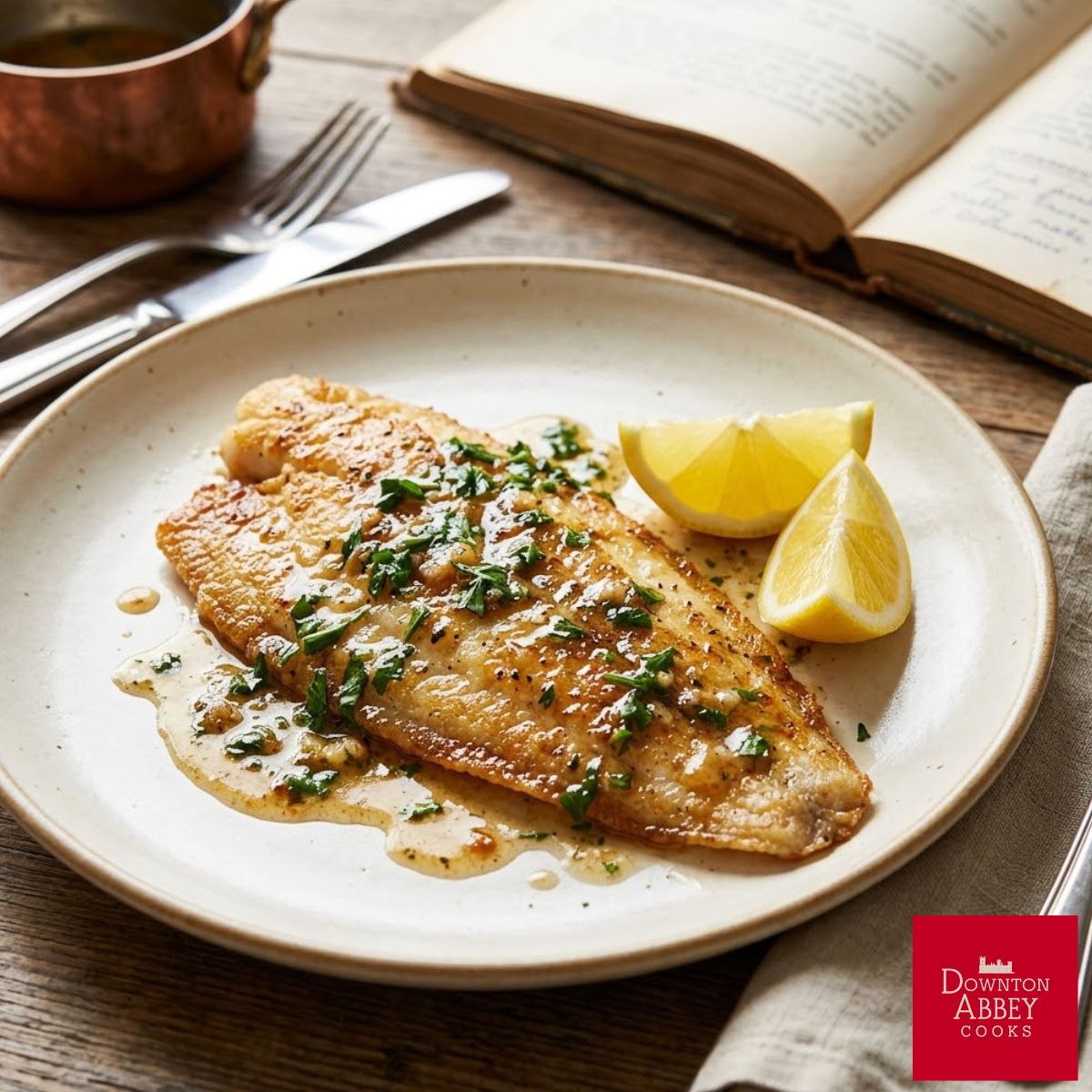
Sole Meunière, Delmonico Style
Ingredients
- 2 sole fillets lemon sole, petrale sole, or flounder, about 6 oz (170g) each
- 3 tbsp flour
- 1 pinch salt and white pepper
- 2 tbsp butter
- 1 tbsp oil
For the browned butter
- 3 tbsp butter
- 1/2 medium lemon juiced
- 1 tbsp fresh parsley chopped
- Lemon wedges to serve
Instructions
Cook the fish
- Pat the fillets very dry. Season with salt and white pepper, then dust lightly with flour and shake off the excess. Dry fish and a light coating are what give you a clean, golden crust.
- Heat the 2 tbsp butter with the oil in a wide pan over medium-high heat until the butter foams. The oil keeps the butter from burning.
- Lay the fillets in, presentation side down first. Cook for 2 to 3 minutes a side, until golden and just opaque through. Thin fillets need less time.
- Lift the fish onto warm plates and keep it somewhere warm.
Make the browned butter
- Wipe the pan if it looks dark, then add the 3 tbsp fresh butter. Let it melt and keep cooking until it foams, smells nutty, and turns golden brown. Watch it closely, as it goes from brown to burnt quickly.
- Take the pan off the heat and stir in the lemon juice and parsley. It will sizzle.
- Pour the browned butter over the fish. Add a lemon wedge and serve at once, while everything is hot.
Notes