
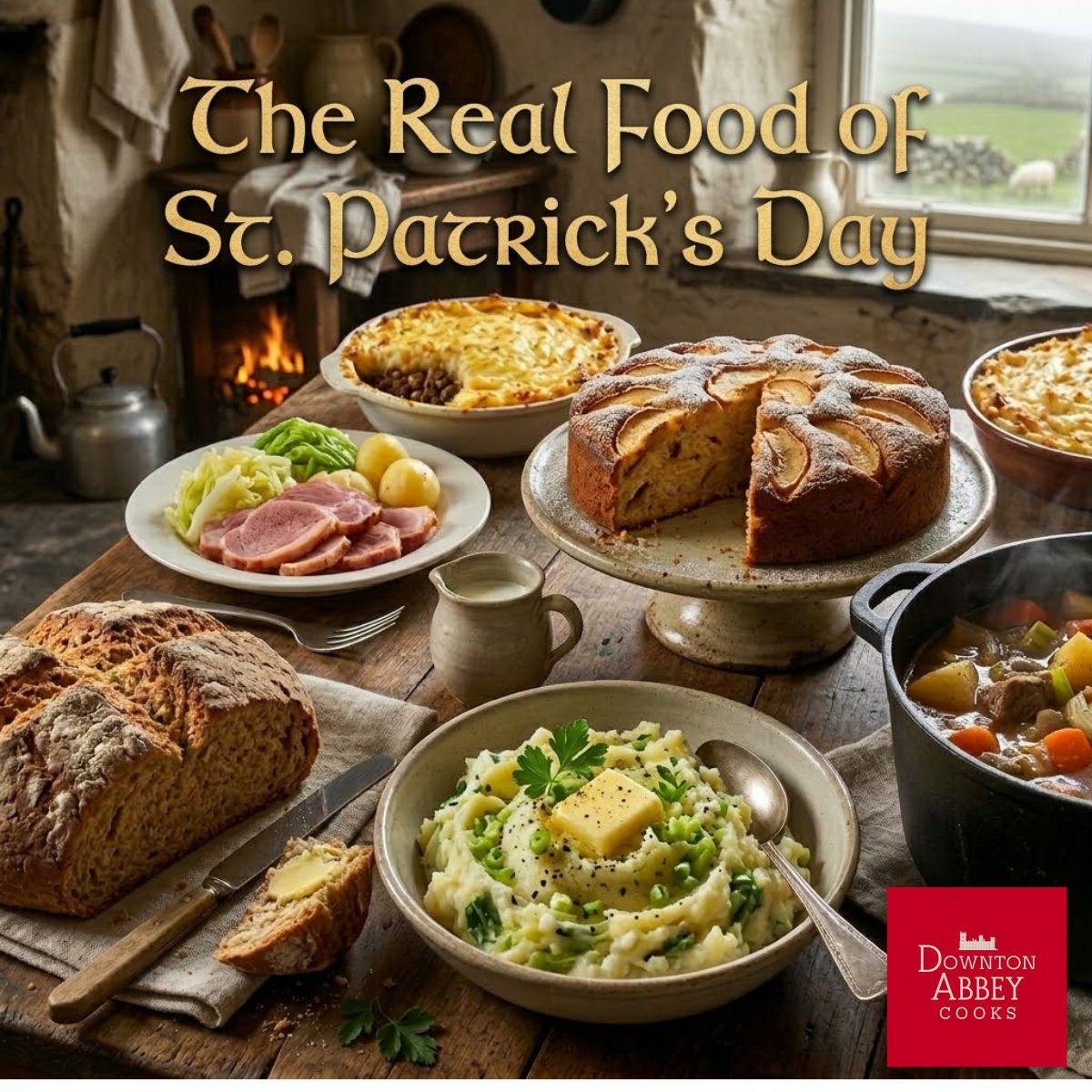
 Somewhere between the green beer and the leprechaun cupcakes, St. Patrick’s Day lost its kitchen.
The holiday has been reduced to a single colour — green frosting, green rivers, green plastic hats. But if you want to understand what this day actually means, skip the food colouring and look at what the Irish really ate, why they ate it, and what those dishes tell us about one of history’s most remarkable stories of survival.
Because every dish on the Irish table is a document. And the story it tells is far more interesting than anything you’ll find at the bottom of a green pint glass.
The Potato Changed Everything — Twice
You cannot talk about Irish food without talking about the potato. Introduced to Ireland in the late 16th century, the potato became the near-exclusive food source for the poorest Irish by the early 1800s. It grew easily in Ireland’s damp soil, produced high yields on small plots, and was one of the few crops that could sustain a family on the tiny parcels of land left to them under colonial tenancy.
Then came An Gorta Mór — the Great Famine of 1845–1852. A blight destroyed the potato crop, and a million people starved. Another million emigrated. Ireland’s population has never recovered to pre-famine levels.
But here’s what most people skip over: Ireland was producing and exporting food throughout the entire catastrophe. Grain, cattle, and dairy continued flowing out of Irish ports under armed guard, bound for English markets. The famine wasn’t simply a crop failure. It was a political disaster built on colonial extraction.
Every potato dish on the Irish table carries that weight — and also the ingenuity of people who rebuilt a cuisine from the wreckage.
Colcannon: Comfort Built from Almost Nothing
Colcannon — mashed potatoes folded with cabbage or kale, enriched with butter and milk — is the dish most people think of as quaint pub food. It’s not. It’s the food of people who survived on what they could grow in small plots after the famine reshaped everything about Irish agriculture and land use.
The name comes from the Gaelic cal ceannann, meaning “white-headed cabbage.” In Irish folklore, colcannon was traditionally served at Halloween with coins or charms hidden inside to foretell the future — a coin meant wealth, a ring meant marriage. But the dish itself was eaten year-round, because potatoes and cabbage were what you had.
What makes colcannon brilliant is its simplicity. Two cheap, abundant vegetables, made rich with butter and seasoned with nothing more than salt and scallions. It’s peasant engineering: maximum comfort from minimum resources.
Downton fans will remember that this kind of hearty, below-stairs food would have been a regular feature of the servants’ hall at the Abbey. I’ve shared my own take on this classic — a comforting colcannon served alongside bangers at Bates’ Red Lion, inspired by the episode where Lord Grantham ventures out to bring Bates home. And for those watching their carbs, I’ve also developed a keto-friendly version that swaps cauliflower for potatoes without sacrificing the dish’s soul.
Irish Soda Bread: Four Ingredients and a Story of Resilience
If colcannon tells the story of what the Irish grew, soda bread tells the story of how they cooked.
Most Irish homes didn’t have ovens with regulated temperature — they had hearth fires and cast-iron pots. Yeast bread requires consistent, controlled heat. Soda bread requires only four ingredients — flour, salt, baking soda, and buttermilk — and a pot with a lid over a fire. The acid in the buttermilk reacts with the baking soda to create the rise, no yeast or proofing needed.
Baking soda itself only became widely available in the mid-1800s, which is why soda bread is a relatively modern invention despite feeling ancient. The cross scored into the top of every loaf isn’t just decorative — it lets heat penetrate the dense dough evenly. In Irish superstition, it was said to “let the fairies out” and ward off evil. The practical and the mystical, baked together.
Buttermilk, the other key ingredient, was a byproduct of butter-making — a resourceful way to use what would otherwise be waste. Nothing went unused in an Irish kitchen.
I’ve written extensively about the history of Irish soda bread on the blog, along with my own recipe that takes about forty minutes and produces a loaf that will make your kitchen smell like a country farmhouse. I’ve included variations for brown soda bread, cheese and herb, and a sweet version with cranberries — because once you master the basic four-ingredient formula, the possibilities are endless.
Irish Stew: The One-Pot National Dish
Irish stew is widely considered Ireland’s national dish, and like everything else on this list, its origins are rooted in practicality. A family with one good pot, a bit of lamb or mutton (the cheapest cuts — neck and shoulder), potatoes, onions, and whatever root vegetables were at hand could produce a meal that fed everyone and stretched across days.
The traditional version uses no stock — the long, slow cooking of lamb and potatoes creates its own broth. Carrots were a later addition. Guinness is a modern embellishment, though a delicious one.
What makes Irish stew different from other European stews is its restraint. French stews build complexity through technique — browning, deglazing, reduction. Irish stew builds depth through time. You put everything in the pot, and you wait. There’s a philosophy in that.
The Crawley family’s Irish connection through Tom Branson gave me a perfect excuse to explore Irish stew on the blog, along with the science of cooking with alcohol — because a splash of stout in your stew isn’t just tradition, it’s chemistry.
Shepherd’s Pie: Leftovers Elevated
Shepherd’s pie — minced lamb topped with mashed potato — is another dish born from the “waste nothing” ethos of British and Irish kitchens. It dates back to the 1800s, when frugal housewives in the sheep-raising regions of northern England, Scotland, and Ireland found ways to make leftover roasted meat into a second meal. The mincing machine made this practical, and the potato — finally accepted as human food rather than pig feed — provided the golden crust on top.
Properly speaking, shepherd’s pie uses lamb. When you use beef, it’s cottage pie. The distinction matters to the people who invented it.
I’ve shared my own lightened-up shepherd’s pie recipe on the blog, using lean meats and a few tweaks that make it feel lighter without losing its comfort. I also wrote about how shepherd’s pie became a healing meal on Downton Abbey — the kind of below-stairs food that Mrs. Patmore would have turned to when the household needed something solid and restorative.
Corned Beef and Cabbage: The Dish That’s Barely Irish
Here’s the one that surprises everyone: the most “Irish” dish in North America is an immigrant invention.
In Ireland, the traditional St. Patrick’s Day meal was bacon and cabbage — not corned beef. Corned beef became the Irish-American substitute because Irish immigrants living in New York’s Lower East Side in the late 1800s couldn’t afford the bacon they’d known at home. What they could afford was brisket, purchased from their Jewish neighbours. The Jewish community had perfected the art of salt-curing beef, and the Irish adapted it to their own traditions.
Corned beef and cabbage is a dish born from immigrant solidarity — two communities sharing a crowded, difficult city and making the best of what was available and affordable. That’s a far better origin story than anything involving shamrocks.
Irish Apple Cake: No Green Icing Required
If you want to know the difference between Irish baking and what passes for St. Patrick’s Day dessert in most North American bakeries, compare an Irish apple cake to a green-frosted cupcake.
Irish apple cake — sometimes called Kerry apple cake — is the kind of dessert that exists in every farmhouse kitchen in Ireland, each family with its own version, none of them written down properly until someone’s grandmother was in danger of taking the recipe with her. It’s a simple, not-too-sweet cake studded with tart apples (Granny Smiths, ideally), lightly spiced with cinnamon and cloves, and baked until the top turns golden and crunchy.
There’s no elaborate frosting. No fondant. No food colouring. The sweetness comes from the fruit itself and a modest dusting of sugar. Traditionally, these cakes were baked in cast-iron skillets over a stove — ovens were a luxury in rural Irish homes well into the 20th century. Crab apple trees grew wild across Ireland, making apples one of the most accessible fruits for home baking.
What makes Irish apple cake so distinctly Irish is its restraint. Like soda bread, like colcannon, it doesn’t try to impress with complexity. It trusts simple ingredients to do the work. Served warm with a pour of custard sauce, a dollop of cream, or just on its own with a cup of strong tea, it’s the kind of dessert that makes you wonder why anyone ever thought cake needed to be more complicated than this.
I’ve shared my own Traditional Irish Apple Cake recipe on the blog — spiced with cloves and cinnamon, baked in a springform pan, and finished with just a dusting of powdered sugar. It’s the kind of thing Mrs. Patmore would have produced for a quiet afternoon in the servants’ hall, and it’s infinitely more satisfying than anything dyed green.
The Edwardian Connection
For those of us who love the Downton era, it’s worth remembering that the Ireland of Mrs. Patmore’s kitchen was still living in the shadow of the famine. The Crawleys’ Irish storyline — Branson’s politics, his marriage to Sybil, the burning of the estate — wasn’t just dramatic fiction. It reflected real tensions in a country that was fighting for independence and still feeding itself from the same potatoes and cabbage that had sustained it through centuries of hardship.
The food of the servants’ hall at Downton — shepherd’s pies, stews, soda bread, colcannon, apple cake with a cup of tea — was the food of the British Isles’ working people. It crossed the Irish Sea and the class divide alike. Mrs. Patmore would have known every dish on this list.
Cook Something Real Today
St. Patrick’s Day is worth celebrating, but it deserves more than green beer. So today, instead of reaching for the food colouring, try reaching for:
Irish Soda Bread — Four ingredients. Forty minutes. The most honest bread you’ll ever bake.
Colcannon — Potatoes, cabbage, butter, and the warmth of a dish that has fed families for generations. Or try the keto version if you’re watching carbs.
Irish Stew — One pot, cheap cuts of lamb, root vegetables, and time. Add a splash of Guinness if the spirit moves you.
Shepherd’s Pie — The ultimate leftover makeover, made with love and mashed potatoes.
Irish Apple Cake — Tart apples, warm spices, a dusting of sugar. Not a drop of green icing in sight.
Each of these dishes is a small act of remembrance — a connection to people who fed their families under impossible circumstances and created a cuisine that endures because it was built on truth, not trend.
Lá Fhéile Pádraig sona duit. Happy St. Patrick’s Day.
Now go make something worth eating.
What’s your family’s St. Patrick’s Day food tradition — the real one, not the green cupcake version? I’d love to hear. Drop me a comment below or find me on Substack.