In North America, Mother’s Day is celebrated on the second Sunday in May. Currently, there are close to 70 countries that officially celebrate Mother’s Day, but at different times of the year. In the UK and Ireland, it is called “Mothering Sunday” and falls on the fourth Sunday of Lent. Mothering Sunday this year is March 15th.
But Mothering Sunday didn’t start as a celebration for mothers at all.
The Mother Church, Not Your Mother
It began in the 16th century. The word “mothering” referred to the “mother church” — the main church or cathedral of the region, or the church in which one had been baptized. It became a tradition that, on the fourth Sunday of Lent, people would return to their mother church for a special service. This pilgrimage was known as “going a-mothering”, and became something of a holiday event.
The day coincides with Laetare Sunday, also called Mid-Lent Sunday or Refreshment Sunday — a day of respite from fasting halfway through the penitential season of Lent. The strict rules were relaxed: the organ could be played in church, rose-coloured vestments replaced the sombre purple, and families were permitted to enjoy rich foods that were otherwise forbidden during the forty-day fast. The Gospel reading for the day is John 6:1–14, the story of the Feeding of the Five Thousand — a fitting theme for a day that became all about food and family reunion.
A record from 1644 captures the spirit of the day perfectly: families in Worcester would gather at the home of the eldest family member for a feast, and they called it “the Mothering-day.”
A Rare Day Off for Servants
For domestic servants — like our beloved downstairs staff at Downton Abbey — Mothering Sunday was one of the very few days off they received all year. It was often the only time whole families could gather together, since on other days they were kept apart by the demands of service. Children and young people who were given this day off to visit their families would pick wild flowers along the way to place in the church or give to their mothers. Daffodils, primroses, and violets gathered from the hedgerows along the walk home — it’s a lovely image, and one that explains why flowers remain so central to the day. In urban settings, churches would supply the children with violets.
Imagine our Mrs. Patmore sending Daisy off with a basket of food for her family, or Anna making the journey back to her mother’s home with a posy of spring flowers. The reunion itself was the real gift.
How Mothering Sunday Became Mother’s Day
By the 1920s, the custom of keeping Mothering Sunday had largely lapsed across most of Europe. It took Constance Adelaide Smith, an Anglican woman from Nottingham, to revive it. Smith had taken note of the American Mother’s Day movement, which had been established as a national holiday in the United States in 1914 thanks to the campaigning of Anna Jarvis, who held the first official observance to honour her own mother at a church in West Virginia. Inspired by Jarvis’s efforts, Smith created the Mothering Sunday Movement and, in 1921, published a book asking for the renewal of the festival. She argued that the day should honour not just biological mothers, but the Mother Church, the Virgin Mary, and Mother Nature.
The wider revival came through the influence of American and Canadian soldiers serving abroad during World War II who brought the idea of “Mother’s Day” with them. The old religious traditions merged with the newer commercial ones, and by the 1950s Mothering Sunday was celebrated across the UK — though increasingly as a secular occasion for honouring mothers with cards, chocolates, and gifts. Traditionally, after church, families would tuck into a Sunday dinner of either roast lamb or veal, and mother would be made Queen of the feast.
In modern Britain, “Mother’s Day” has become the common name in commercial contexts thanks to American influence, but the Church of England still invites people on Mothering Sunday to visit the parish church or cathedral in which they were baptized.
The Traditional Mothering Cake: Simnel
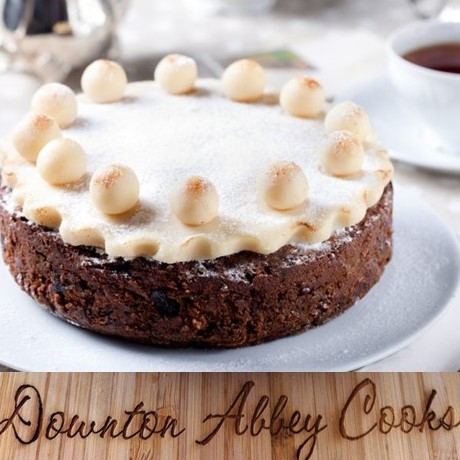
No Mothering Sunday would be complete without Simnel cake. Simnel cakes originated in the medieval era and are also known as the Mothering Cake. Mothering Sunday was sometimes even called “Simnel Sunday” after it.
The word “simnel” likely derives from the Latin simila, meaning fine flour — the whitest and best quality available. References to simnel appear as far back as the 13th century, though it began life as a yeast-leavened bread rather than a cake. It would have been nothing like the rich confection we know today — more likely a bread dough enriched with egg and dried fruit, made special simply by using the finest flour a household could afford.
Medieval observers were not allowed to consume dairy products for the rest of Lent, which ruled out many baked goods. Mothering Sunday marked a temporary break from the fast, allowing people to eat simnel cake, which contained butter and eggs. Think of it as the mirror image of Pancake Tuesday, when eggs and milk are used up before Lent begins. On Refreshment Sunday, you could finally indulge in them again.
By the Stuart era, the simnel had evolved from bread into something closer to a pudding. It was boiled and then baked — a technique that spawned a charming folk tale about a couple named Simon and Nelly who quarrelled over whether the cake should be boiled or baked. They compromised on a recipe using both techniques, and “Simon and Nelly” was supposedly contracted into “Simnel.” It’s almost certainly fiction, but it’s a wonderful story. Different towns had their own recipes and shapes — Shrewsbury, Bury, and Devizes each claimed their version as the original.
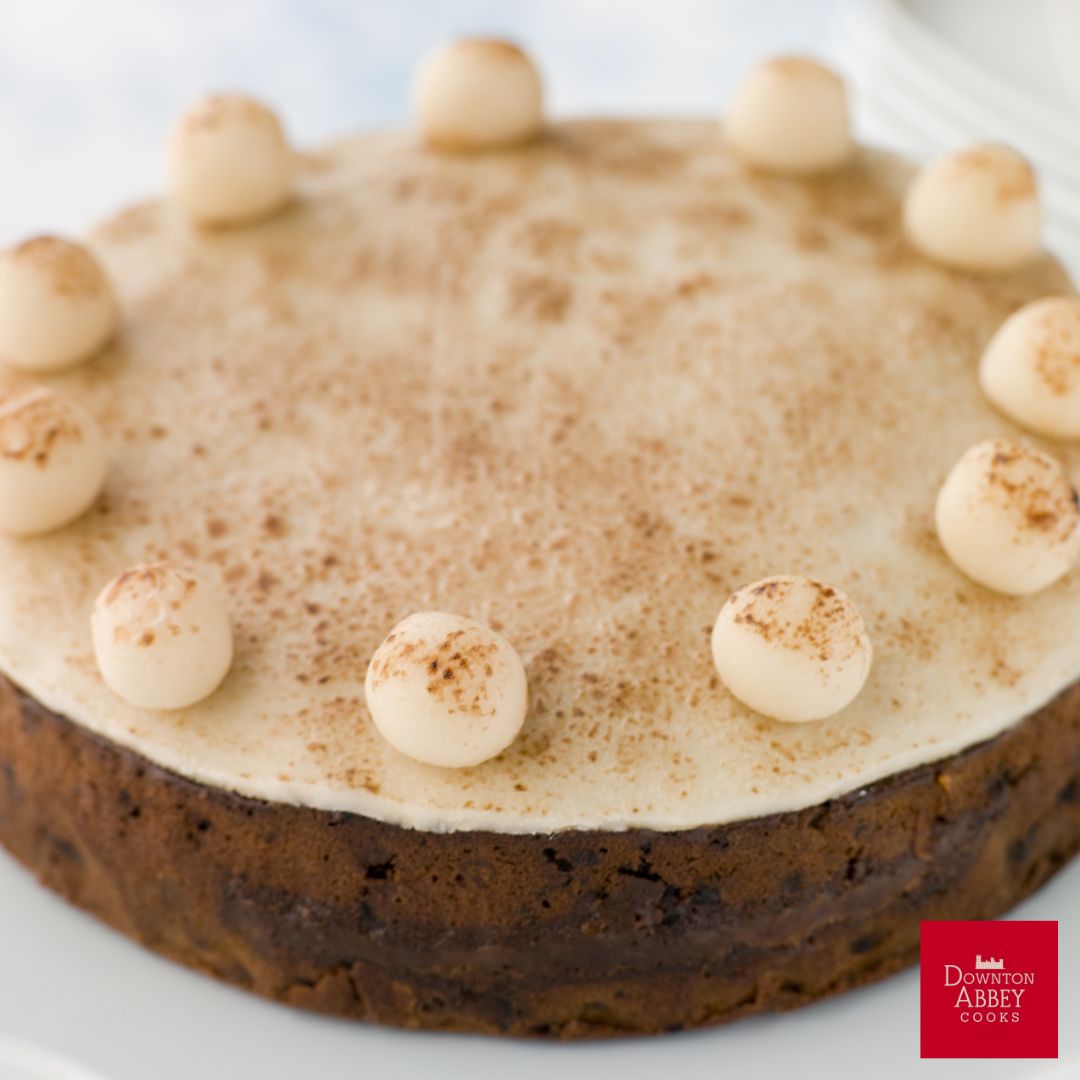
The modern Simnel cake, as we recognize it — a light fruitcake with marzipan baked into the middle, another layer spread on top, then toasted under the grill until golden — only began to take that familiar form toward the end of the 19th century. The eleven marzipan balls representing the true disciples of Jesus (omitting Judas) are also a relatively modern addition. In some variations, Christ is represented by the placement of a twelfth ball in the centre.
Whether you’re celebrating Mothering Sunday or Mother’s Day, the spirit of the day remains the same — gathering with family, sharing good food, and honouring the women who shaped us. Mrs. Patmore would approve.
Spring Time Simnel Cake
Ingredients
Almond Paste
- 2 cups ground almonds*
- 1 large egg yolk lightly beaten
- 3 -4 tbsp. orange juice
- 5 drops almond extract
Cake
- 1 3/4 cups unbleached all purpose flour
- 3 tsp, baking powder
- 2 tsp. ground nutmeg
- 2 tsp. ground cinnamon
- 1 lb. mixed dried fruit currants, dark and golden raisins, red glace cherries
- 1/4 cup candied citrus peel chopped
- 1 large orange zested
- 3/4 cup unsalted butter
- 1 cup caster sugar or sugar substitute
- 3 large eggs
- 2 tbsp. milk
- 2 tbsp. apricot jam,

Instructions
Make Almond Paste
- Making your own almond paste is much better than store bought which tends to have too much sugar and which may liquefy under the broiler.
- To make your own almond paste you will need a food processor fitted with a steel blade.
- Process the icing sugar and ground almonds, slowly dripping in egg yolk, orange juice and almond essence. The mixture should form a pliable paste.
- Set aside a small portion for 11 balls to decorate the cake. Roll out the remaining paste into 2 circles which are the approximate size of your baking pan.
- You can use the bottom of the pan to trace an outline and cut inside the line to ensure a good fit.
Make Cake
- Preheat oven to 325°F. Prepare a 9 inch spring form pan, by lightly greasing the bottom and sides.
- Sift flour, salt and spices together, then stir in fruit and peel.
- Cream butter and sugar thoroughly until light and creamy, then beat in eggs one at a time, until the mixture is fluffy. Reserve a teaspoon of egg for finishing the cake later.
- Gently stir flour and fruit into the creamed mixture in two stages, adding a little more milk to give the mixture a dropping consistency.
- Place half the mixture into the prepared pan. Place one pre-rolled round of almond paste on top. Cover with remaining cake mixture.
- Before baking the cake, give the pan a few sharp taps on a firm surface. This settles the mixture and prevents holes from forming in the cake.
- Place the pan on a baking sheet. To prevent the cake from drying out, wrap corrugated cardboard — extending about an inch above the pan — and secure it with twine.
- Bake in the centre of the oven for 1 hour. Lower the heat to 300°F and bake for an additional 3 hours or until a thin metal skewer inserted in the centre of the cake comes out clean.
- Level the cake by placing a heavy pot on top of the cooked cake while it is still hot.
Finish
- When the cake has cooled slightly, remove the pot and the cardboard, and place the cake on a wire rack, allowing to cool completely in the pan.
- Brush the top of the cake with apricot jam which has been warmed, then cover the top of the cake with the second round of almond paste.
- Roll 11 small balls of retained paste and place evenly around the edges on top of the cake.
- Brush the top with a little beaten egg and very lightly brown under the grill until the almond paste turns light golden brown.
- Remove and leave to cool. You can now release the clip on the spring form pan.
- I like it plain, but many people also decorate with a ribbon tied around the base, particularly for Mothering Day, and a few edible flowers placed on the top.